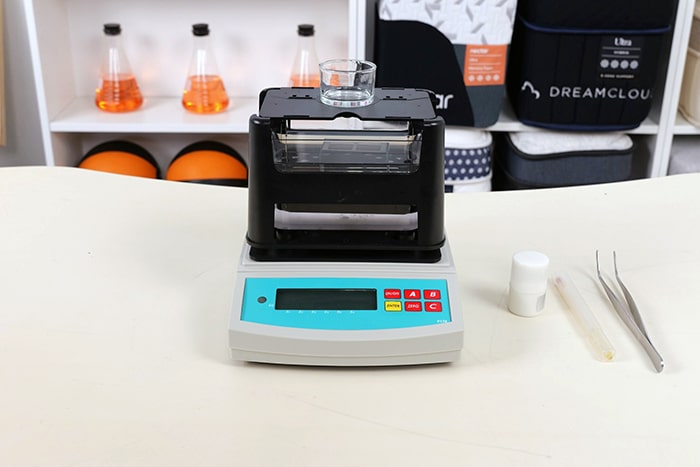
At NapLab, we use a high-precision digital scale (resolution of 0.005 grams), high-precision digital caliper (resolution within 0.01 mm), and densimeter to measure foam density. The digital caliper is also used to measure coil thickness, which we can translate into coil gauge measurements.
In addition, many brands have also sent NapLab their exact foam densities, ILD ratings, and coil gauges. Any time we have the manufacturer’s data we will publish it alongside our testing data.
Foams that are more dense and coils that are thicker are typically higher quality, last longer, perform better, and sag less. Both foam density and coil thickness measurements are a useful data point as part of our larger mattress analysis.
In This Guide
Densimeter | Digital Caliper | Importance | Foam & Coil Data | Testing Protocol | FAQs
What does a densimeter measure?
A densimeter measures the density of various materials. In our case, we’re using it to measure the density of foam samples.
The densimeter provides density measurements in pounds per cubic feet (PCF).
What does a digital caliper measure?
A digital caliper is used to measure the physical dimensions of an object with an incredibly high degree of accuracy.
In our case, we’re using it to measure the thickness of coil wires. Our digital caliper has a resolution of 0.0005″ / 0.0127 mm. Once we’ve taken a caliper measurement, we then convert that to a coil gauge.
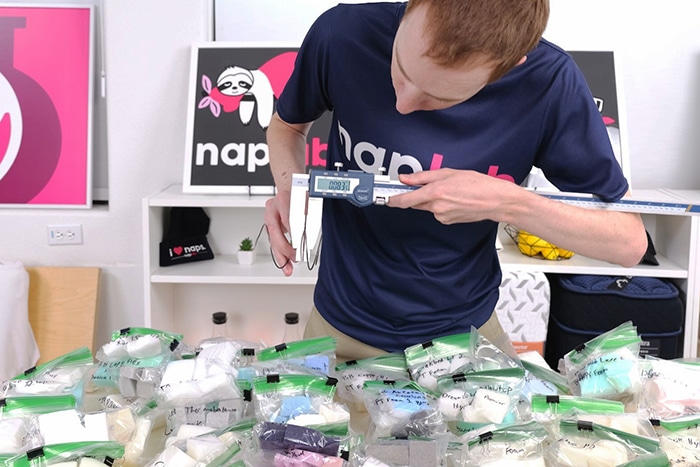
We also use the digital caliper to measure the dimensions (L x W x H) of foam samples. We use those measurements to determine a precise volume as one of the inputs for our foam density measurements. Once we’ve calculated the volume, we can calculate density by taking a dry measurement weighing of the foam sample.
Why are foam density and coil gauge important?
Foams that are more dense typically perform better, last longer, sag / dip less, and form less dramatic body impressions. Mattresses that use foams that are higher density and thicker are typically better than mattresses using lower density foams and/or foam layers that are thinner.
Coils that are a lower gauge are using a thicker wire. For example, a 13 gauge coil is thicker than a 15 gauge coil. Thicker wires used in mattress coil units typically are last longer and provide better support.
However, there are other relevant factors impacting coil performance including number of coil turns, intended firmness level (IE, thinner coils are typically softer than thicker coils), coil placement (edge vs. center vs. zoning), steel quality, number of coils, and coil diameter, among other coil attributes that impact performance. All that said, in most cases, it is preferable to have a lower gauge coil (which is a thicker wire).
Foam Density & Coil Gauge Testing Data
Below is a complete list of all mattress foam density and coil gauge data we’ve collected to date. The data in bold comes from our in-house tests using our dimensional density analysis, densimeter, and digital caliper, while the data in italics comes from the manufacturer’s provided specs.
Where does this data come from?
In early 2026, we began testing foams using a densimeter and coils using a digital caliper. We collected foam and coil samples for testing from 73 different mattresses we had available for testing.
Unfortunately, many previous mattresses we’ve tested we no longer have available to test. As a result, we won’t have data for those mattresses.
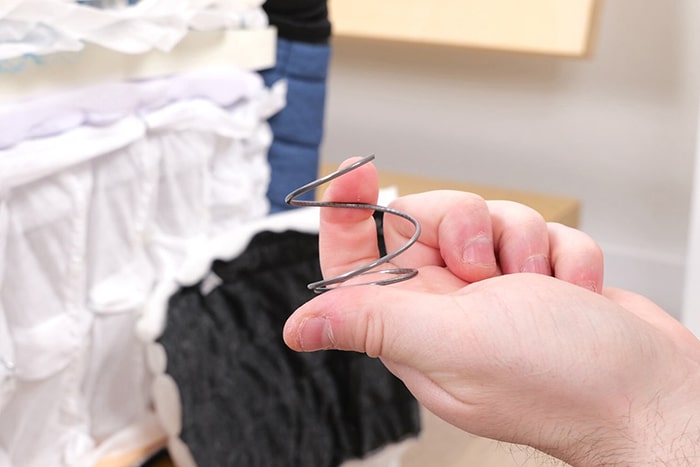
Moving forward, we’ll be collecting foam density and coil gauge data for all mattresses we test.
In September 2026, we began using dimensional density analysis (which uses precise dimensional measurements and precise weighing) as the primary density measurement method and using our densimeter (which uses water displacement testing) as a secondary testing method when required.
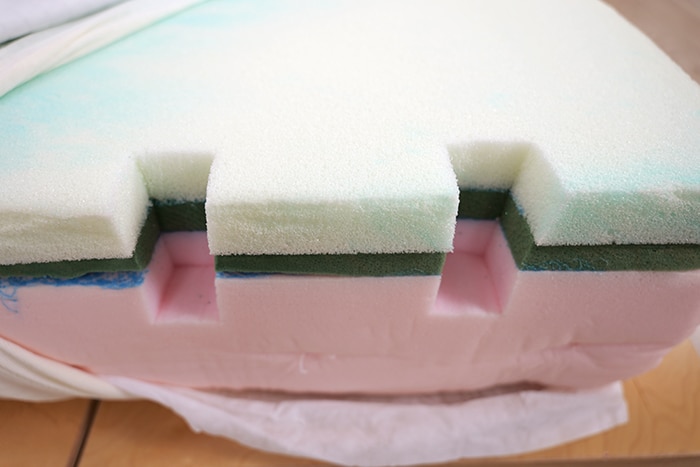
In cases where we do not have our own tested foam density and coil gauge data we will provide the foam and coil layer specs sent to us by the mattress brand (provided they were willing to share that data). NapLab tested data is indicated with bold text, while manufacturer’s data is indicated with italics text.
Testing Process & Protocols
The following are our testing processes for measuring foam density and measuring coil thickness.
Foam Density Tests
Method 1 – Dimensional Density Analysis
Our primary testing method measures the length, width, and height of a foam sample that has been cut into a rectangular shape. We take these measurements using a digital caliper that has a resolution of 0.01 mm. We then weigh the sample with a high-precision scale that has a resolution of 0.005 grams.
Next, we calculate the density using the following equation:
Finally, we convert our density measurement into pounds per cubic feet (PCF), which is the standard density measurement that mattress brands us.
Our testing process includes the following steps:
- Collect a small foam sample, ensuring it is free of adhesives, debris, or other contaminants.
- Measure the length, width, and height of the foam sample with our digital caliper.
- Measure the weight of the sample with our high-precision digital scale.
- Calculate the density using the above formula.
- Convert density to pounds per cubic feet (PCF).
Method 2 – Water Displacement Analysis
When foam samples are impossible to collect in a sufficiently uniform shape or they have holes in them we use our electronic densimeter.
In this method, the densimeter measures volume using water displacement, also known as Archimedes’ principle. Furthermore, we follow the saturation density testing method to account for the porous nature of foam material.
Below is the mathematical formula used in this method for calculating density. Here, volume is represented by the mass of the displaced water.
By using this approach, we bypass the need for precisely cutting geometric samples to achieve an accurate volume measurement.
Our testing process includes the following steps:
- Collect a foam sample of approximately 0.5 – 1.5 grams, ensuring it is free of adhesives, debris, or other contaminants.
- Weigh the foam sample in a normal (dry) state.
- Saturate the foam sample completely in distilled water to avoid absorption in step 5.
- Weigh the foam sample in its saturated (wet) state.
- Submerge the saturated foam sample in the densimeter water tank to get the weight of the submerged sample.
- Calculate the density of the foam by dividing its dry mass (step 2) by the weight of the water displaced, which is calculated as the difference between the saturated and submerged masses (steps 4 and 5).
The primary data point we collect and analyze is foam density:
Foam Density – This is how dense or heavy a particular piece of foam is (measured in pounds per cubic feet, PCF). Foams that are more dense have more foam material in them. Two foam layers can look the same, sound the same, and be the same thickness, but also have different densities and foam formulations, causing their performance to differ dramatically. Foam quality exists on a spectrum of performance. Higher density foams typically last long, perform better, are higher quality, and sag less.
The rating scales below provide a general guideline on the quality levels of different types of foam and their respective densities.
Poly Foam
Outstanding
≥ 3.0 PCF
Excellent
2.5-2.9 PCF
Good
2.0-2.4 PCF
Fair
1.5-1.9 PCF
Mediocre
1.2-1.4 PCF
Poor
1.0-1.2 PCF
Terrible
< 1.0 PCF
Memory Foam
Outstanding
≥ 6.0 PCF
Excellent
4.0-5.9 PCF
Good
3.0-3.9 PCF
Fair
2.5-2.9 PCF
Mediocre
2.2-2.4 PCF
Poor
2.0-2.1 PCF
Terrible
< 2.0 PCF
Latex
Latex is a notably denser / heavier foam compared to most poly and memory foam, as a result, PCF is considerably higher. PCF is not often used as a measure for latex, instead, you’ll more often see ILD (indentation load deflection), which is a measure of firmness. In any case, we still make a point to measure latex in PCF for consistency in our testing.
Outstanding
≥ 5.5 PCF
Excellent
5.0-5.4 PCF
Good
4.5-4.9 PCF
Fair
4.0-4.4 PCF
Mediocre
3.5-3.9 PCF
Poor
3.0-3.4 PCF
Terrible
< 3.0 PCF
Testing Limitations
Our density tests are subject to a number of testing limitations, potential sources of measurement error, and variability that may influence our results. These are the biggest testing limitations as we see them:
- We make an error in testing – the testing steps are incredibly precise, and small errors in the testing process could result in foam densities that are inaccurate. In our preparations for beginning formal testing, we tested 15 foam samples with known densities. Our measurements on average came within 6.5% of the known / stated manufacturer density.
- Variance in surface tension – water “clings” to foam differently after saturating it, due to surface tension, which varies from foam to foam. Treatment with cooling gels, phase change materials, or other hydrophobic coatings can introduce a small margin of error.
- Foams are not always consistent – foams are typically manufactured in large buns and then cut into smaller layers. While the bun on average may be a certain density, individual foam layers that have been cut from that bun may be slightly more or less dense than the overall foam bun average.
- Limited sample size – we are testing a single mattress and it’s always possible that the sample size of one is not an accurate reflection of the typical mattress made by that brand.

- Glue layers – while we make every effort to remove as much glue as possible from the foam layers, there still may be some glue residue on the foams that are increasing the weight.
- Bubbles on samples – some foams are more prone to collecting bubbles around the sample as it is submerged in the densimeter tank. This can throw off measurements as it erroneously provides extra buoyancy to the sample.
- Foam Expansion – certain foams tend to expand significantly when saturated with water. This makes the Archimedes principle and the saturation method unsuitable for measuring density. In these cases, we rely on measuring the volume of the dry foam sample using digital calipers and taking the dry weight on the densimeter. This uses the basic formula for density: mass divided by volume.
Coil Gauge Tests
Our coil gauge test uses a digital caliper to precisely measure the width of the wire thickness used in mattress coil units. Our digital caliper has a resolution of 0.0005″ / 0.0127 mm. Once we’ve taken a caliper measurement we then convert that to a coil gauge.
Our testing process includes the following steps:
- Collect a sample of at least 3-5″ of coil from the mattress.
- Ensure the sample is free of adhesives, unavoidable kinks, and other debris that would make the coil less uniform.
- Use digital calipers to take two measurements perpendicular across the coil sample.
- Average those measurements together and reference the Washburn & Moen conversion chart to get the steel gauge number.
Washburn & Moen (Or American SWG) Standard For Converting Steel Coil
| W&M Gauge | Thickness (Inches) | Thickness (mm) |
|---|---|---|
| 12 | 0.1055″ | 2.68 mm |
| 12.5 | 0.0985″ | 2.50 mm |
| 13 | 0.0915″ | 2.32 mm |
| 13.5 | 0.0860″ | 2.18 mm |
| 14 | 0.0800″ | 2.03 mm |
| 14.5 | 0.0760″ | 1.93 mm |
| 15 | 0.0720″ | 1.83 mm |
| 15.5 | 0.0670″ | 1.70 mm |
| 16 | 0.0625″ | 1.59 mm |
| 17 | 0.0540″ | 1.37 mm |
| 18 | 0.0475″ | 1.21 mm |
| 19 | 0.0410″ | 1.04 mm |
| 20 | 0.0348″ | 0.88 mm |
The primary data point we collect and analyze is coil gauge (wire thickness):
- Coil Gauge – Coils that use a thicker wire (which is a lower gauge number) typically provide better support, durability, and longevity. However, there are other relevant factors impacting coil performance including number of coil turns, intended firmness level (IE, thinner coils are typically softer than thicker coils), coil placement (edge vs. center vs. zoning), steel quality, number of coils, and coil diameter, among other coil attributes that impact performance. All that said, in most cases, it is preferable to have a lower gauge coil (which is a thicker wire).
Outstanding
≥ 14.0 Gauge
Excellent
14.1-15.0 Gauge
Good
15.1-16.0 Gauge
Fair
16.1-17.0 PCF
Mediocre
17.1-18.0 PCF
Poor
18.1-19.0 PCF
Terrible
< 20.0 PCF
The rating chart above should be considered a general guideline and applies only to large coil units. These ratings are not appropriate for microcoils (which are considerably thinner by design).
Frequently Asked Questions
Your data says my mattress uses high density foams, but it still developed sags, dips, and body impressions. Why?
A high quality, high density mattress that’s placed on a lower quality frame / foundation or not using a high quality waterproof mattress protector can develop sagging, dips, and body impressions more quickly and more deeply.
A high quality frame / foundation is required to provide sufficient support to the mattress. When that support isn’t robust enough, you’ll see the mattress performance, support, and longevity significantly degraded.
In addition, many sleepers choose not to use a waterproof mattress protector (or use a poor quality protector), which also degrades mattress longevity. A typical adult loses 0.5 to 1.0 liter of fluid each night while they sleep. That fluid loss occurs due to breathing and sweating. In addition, oils from skin and hair can also be lost during the night. If you do not use a waterproof mattress protector some of the liquid can get into the mattress. Over time, that liquid will work to significantly break down the foams and other materials, causing sagging, dips, body impressions, and permanent deformations in the mattress.
What can I do to prevent and reduce sagging, dips, and body impressions in the mattress?
First, use a high performance mattress frame / foundation. A high quality frame / foundation provides better support to the mattress, which reduces the sagging and body impressions. The ideal frame / foundation is a solid surface with no gaps. If you do opt for a slatted frame / foundation, ensure the slats are at least 3″ wide, gaps of no more than 3″, slats are rigid (not flexible or bowed), slats are thick (ideally 0.5″ or thicker), and there is a central support beam in the middle.
In addition, any frame should have at least 5 supporting legs, but more is better. More legs ensures a more stable and complete support, which will help to improve longevity and reduce sagging.
Second, use a high performance waterproof mattress protector. A waterproof protector prevents liquid, skin oils, dirt, dust, and other debris from making contact and entering the mattress. The liquids and other contaminants will work to break down the materials in the mattress if not stopped by a waterproof mattress protector.
What bed frames and foundations help to create the best mattress longevity?
The best bed frame and foundation I’ve tested is the Sleeping Duck Indestruct. This frame foundation combo meets and exceeds all of the ideal requirements to prevent and reduce mattress sagging. It has a solid end-to-end surface, while still providing aeration holes for breathability. In addition, we have 6 supporting feet, a full steel support structure, and two supporting steel beams across the middle. It’s expensive, but it’s also an incredibly high performance, high quality frame.
Floyd Bed is another great choice. It’s a solid platform frame foundation combo with end-to-end solid support that is thick, rigid, and incredibly supportive. This is the frame that we use for all mattress testing at NapLab and it’s also the frame I use for personal use.
Winkbed’s Platform Foundation and Amerisleep’s Platform Bed Frame are also good options. While these do use a slat support structure, the slats are rigid, wide, no flex, thick, and there is a central supporting beam. Amerisleep’s frame has 6 legs and Winkbed’s has an impressive 9 legs. These are also both considerably less expensive than the Sleeping Duck Indestruct.
What mattress protectors do you recommend?
The best mattress protector I’ve tested to date is the Bedgear Dri Tech Performance. It’s not cheap, but it’s incredibly breathable, cool, and stretchy, while also being waterproof. This protector won’t get in the way of the mattress cooling performance or feel, which many cheaper mattress protectors will.
Another good option is the SLEEP TITE. Its cooling performance isn’t quite as good, but it’s also considerably less expensive than the Bedgear while still providing the required waterproof protection for the mattress.
I have been using both of these protectors for personal use for nearly a decade. They have held up incredibly well over the years.