Sleep plays a central role in physical health, mental well-being, and daily performance. To better understand how Americans are actually sleeping, NapLab analyzed large-scale survey data to identify national and state-level sleep trends shaping rest in 2026.
This study is based on an analysis conducted in January 2026 using responses from more than 50,000 U.S. adults across all 50 states. The dataset combines 48,000 responses collected throughout 2025 via NapLab’s personalized mattress quiz with an additional 2,400 responses from a nationally distributed survey fielded between December 2025 and January 2026.
Participants answered questions related to sleep duration, sleep quality, habits, challenges, mattress preferences, and lifestyle factors affecting rest. Responses were aggregated and analyzed at both the national and state levels to identify emerging sleep trends and statistically significant patterns across the U.S..
Key Findings
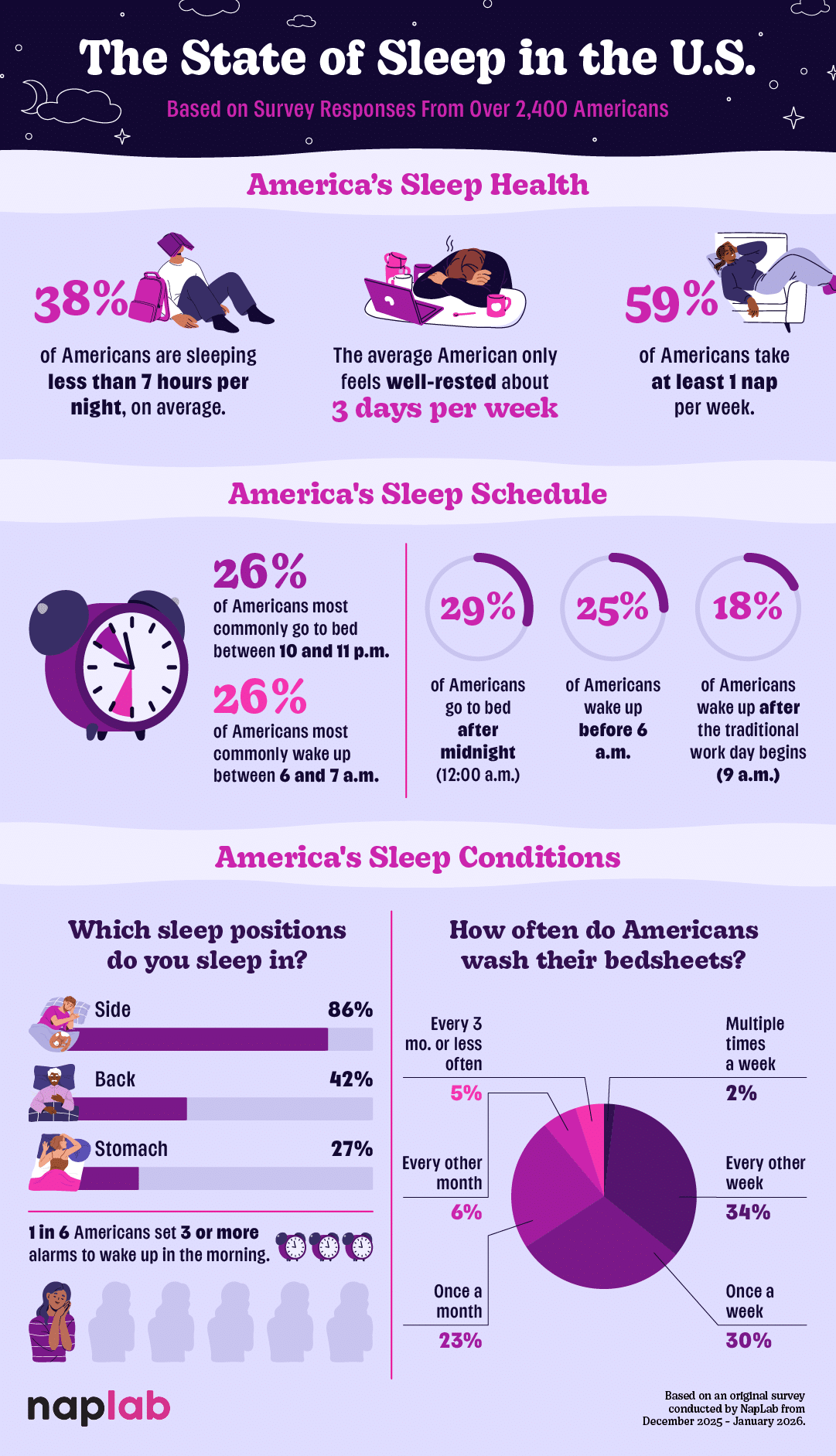
- Americans report sleeping an average of about 7 hours per night, with 38% getting less than 7 hours on average.
- Only 12% of Americans get more than 8 hours of sleep per night.
- The most common bedtime in the U.S. is between 10 and 11 p.m. (26%), followed by 11 p.m. to midnight (21%). A surprising 29% of Americans go to bed after midnight.
- Americans sleep an average of 2 extra hours on weekends or days off, with 26% sleeping in by more than 2 hours.
- Women generally sleep more than men, with only 22% of men getting 8 or more hours of sleep on average, compared to 32% of women.
- Despite sleeping less, men report feeling well-rested more often, averaging 4 days per week, compared to 3 days per week for women.
- Bedtimes generally get earlier with age: 45% of Gen Z go to sleep after midnight, compared to 31% of Millennials, 24% of Gen X, and 23% of Baby Boomers.
- Gen Z gets the best sleep overall, with 74% sleeping at least 7 hours, while Gen X sleeps the least, with 44% sleeping under 7 hours.
- Napping is common across the U.S., with 59% of Americans taking at least 1 nap per week, and the average American napping 1–2 times weekly.
- Americans are primarily side sleepers, with 39% sleeping exclusively on their side and 86% sleeping on their side at least some of the time.
- Mattress preferences skew heavily toward two sizes, with 48% of Americans owning a King mattress and 42% owning a Queen.
Table of Contents
NapLab’s Sleep Survey Visual Summary
How Much Sleep Are Americans Getting in 2026?
From how long Americans sleep each night to when they go to bed and wake up, our sleep statistics offer a closer look at the country’s rest habits. The findings show that many Americans are falling short on sleep during the week and using naps, extra weekend rest, and multiple alarms to keep up.
Average Sleep Duration in the U.S.
Across the U.S., the national average lands right around 7 hours of sleep per night. Our sleep survey data shows that 38% of Americans get less than 7 hours on average, while only 12% get more than 8 hours. On average, Americans only feel well-rested 3 days per week.
How Often Americans Nap
Napping appears to be one way Americans try to make up for not sleeping enough. 59% of Americans take at least one nap per week, with the average American napping 1–2 times weekly.
How Much Americans Sleep In on Weekends and Days Off
Americans sleep an average of 2 extra hours on weekends or days off, with 26% sleeping in by more than 2 hours. This behavior suggests many are compensating for insufficient sleep during the week.
America’s Sleep Schedule: Bedtimes, Wake Times, and Alarms
Understanding when Americans go to bed and wake up provides insight into national rest patterns.
The Most Common Bedtimes in America
America’s most common bedtime is between 10 p.m. and 11 p.m. The next most common time is 11 p.m. to midnight. Notably, 29% of Americans go to bed after midnight.
The Most Common Wake-Up Times
The most common wake-up time is between 6 and 7 a.m. However, early mornings are common, with 25% of Americans waking up before 6 a.m.
How Many Alarms Americans Set
Early mornings don’t come naturally for everyone; 1 in 6 Americans sets three or more alarms to wake up.
Sleep Habits and Bedroom Conditions
The environment and positions in which we sleep significantly impact overall rest quality.
America’s Most Common Sleep Positions
According to our sleep survey, Americans are overwhelmingly side sleepers, with 86% sleeping on their side at least some of the time, compared to 42% on their back and 27% on their stomach. Furthermore, 39% sleep exclusively on their side. (See our guide on how to sleep on your side).
Preferred Sleeping Temperature
The majority (56%) of Americans prefer to sleep in cold or very cold room temperatures; only 9% prefer warm room temperatures.
How Often Americans Wash Their Sheets
Nearly two-thirds of Americans are not washing their sheets weekly, which is noncompliant with the expert-recommended rate to maintain a clean bed. (Learn how often you should wash your bed).
What Are Americans Wearing to Sleep?
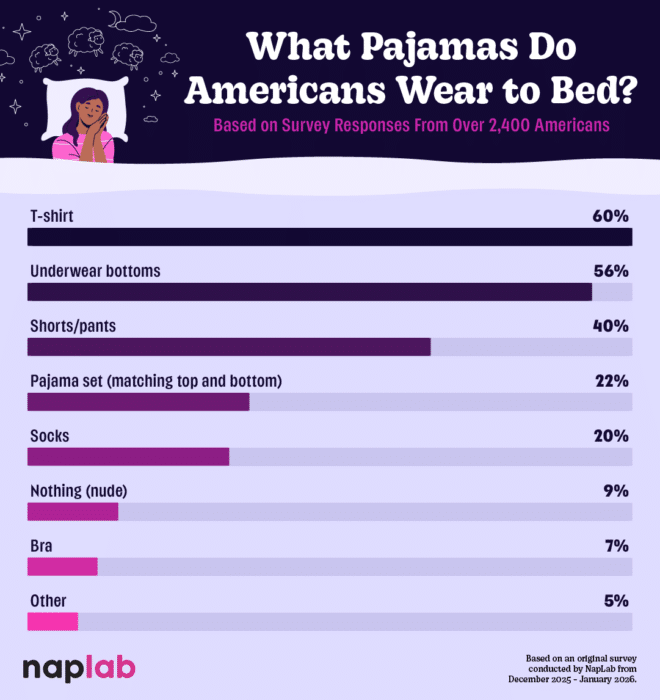
(Bar chart displaying the articles of clothing Americans most commonly wear as pajamas in 2026)
Most Common Pajamas and Sleepwear in 2026
The most common articles of clothing Americans wear to bed are:
- T-shirt (60%)
- Underwear bottoms (56%)
- Shorts/pants (40%)
- Pajama set (22%)
- Socks (20%)
- Nothing/nude (9%)
- Bra (7%)
- Other (5%)
How Sleepwear Varies by Gender
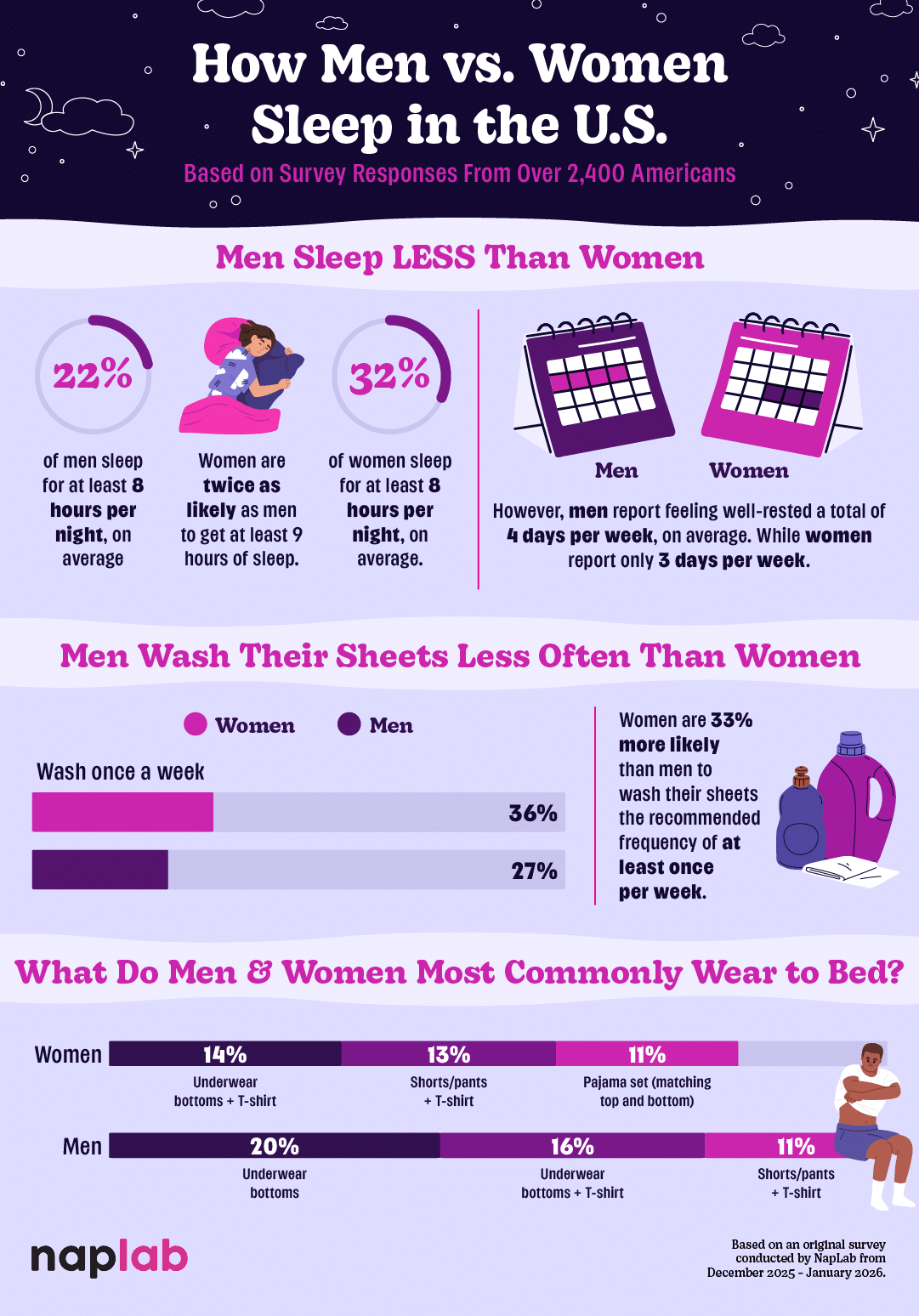
Men most commonly sleep in underwear bottoms (20%), a combination of underwear bottoms and a T-shirt (16%), or shorts/pants and a T-shirt (11%). Women most commonly choose a combination of underwear bottoms and a T-shirt (14%), shorts/pants and a T-shirt (13%), or a pajama set (11%).
2026 Sleep Statistics by State
Which States Get the Most Sleep?
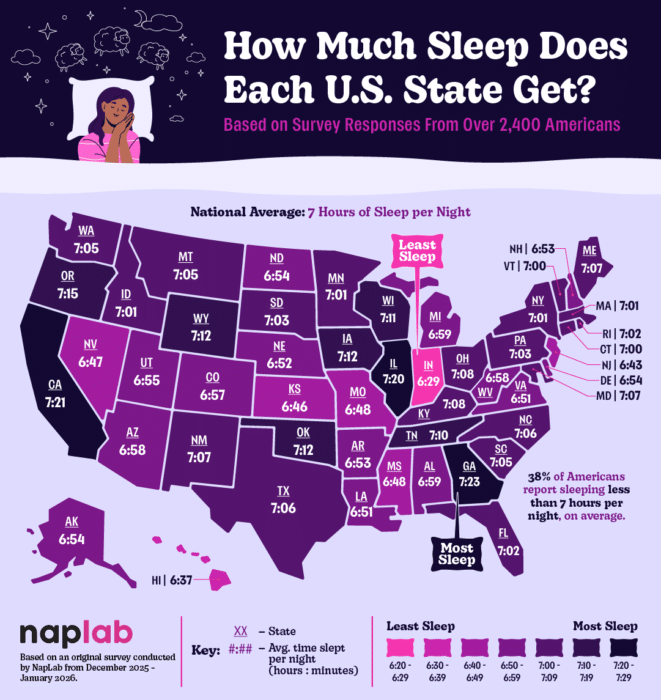
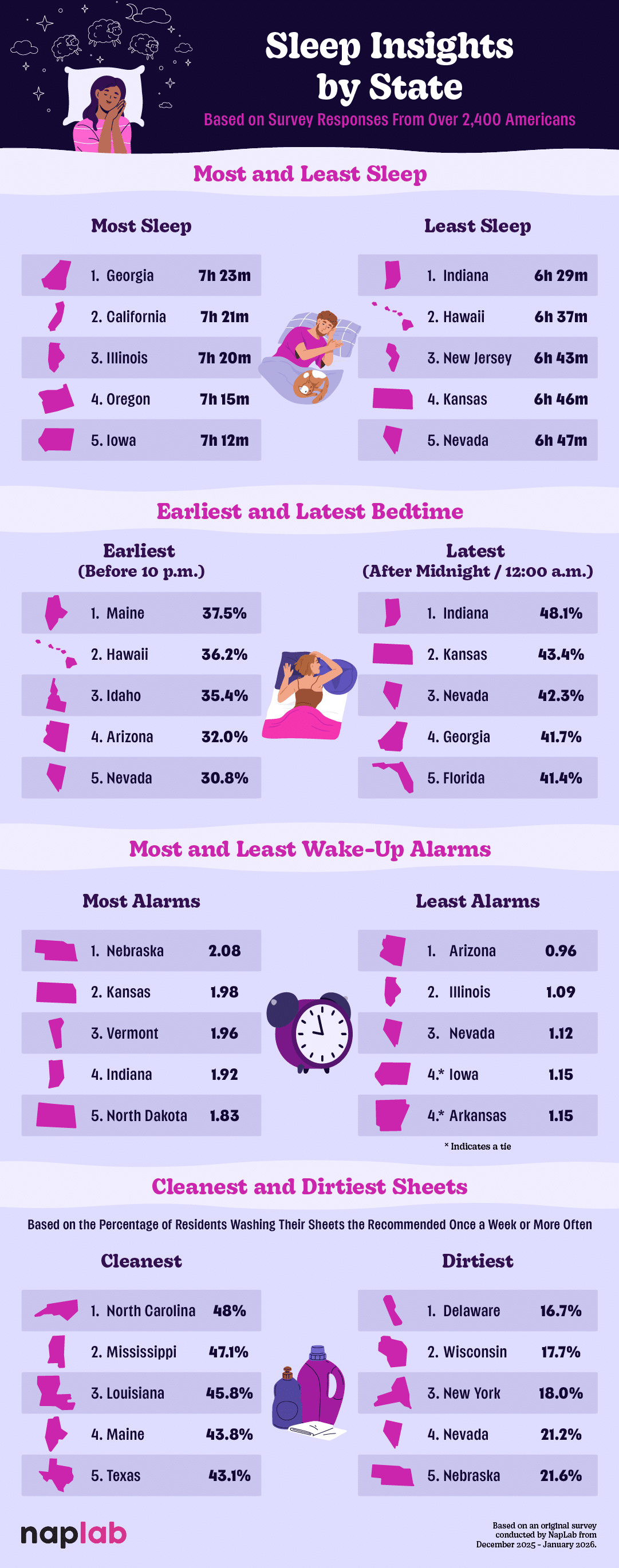
At the top of the list, Georgia reports the highest average sleep duration at 7h 23m, followed closely by California (7h 21m) and Illinois (7h 20m). These sleep statistics place these states comfortably above the national average of 7 hours, and they are among the few where residents clear the seven-hour mark with room to spare.
Which States Get the Least Sleep?
Indiana ranks last, with residents averaging just 6h 29m of sleep per night. Hawaii (6h 37m) and New Jersey (6h 43m) also fall well below the national average. Notably, the bottom ten states all average under seven hours, a threshold the CDC associates with an increased risk of chronic conditions like heart disease and diabetes.
States With the Earliest and Latest Bedtimes
- Earliest bedtime: Maine — 37.5% go to bed before 10 p.m.
- Latest bedtime: Indiana — 48.1% go to bed after midnight
States That Set the Most and Fewest Alarms
- Most alarms set: Nebraska — 2.08 alarms on average
- Fewest alarms set: Arizona — 0.96 alarms on average
States With the Cleanest and Dirtiest Sheets
- Cleanest sheets: North Carolina — 48% wash at least once a week
- Dirtiest sheets: Delaware — 16.67% wash at least once a week
2026 Sleep Statistics by Generation
How Sleep Changes With Age
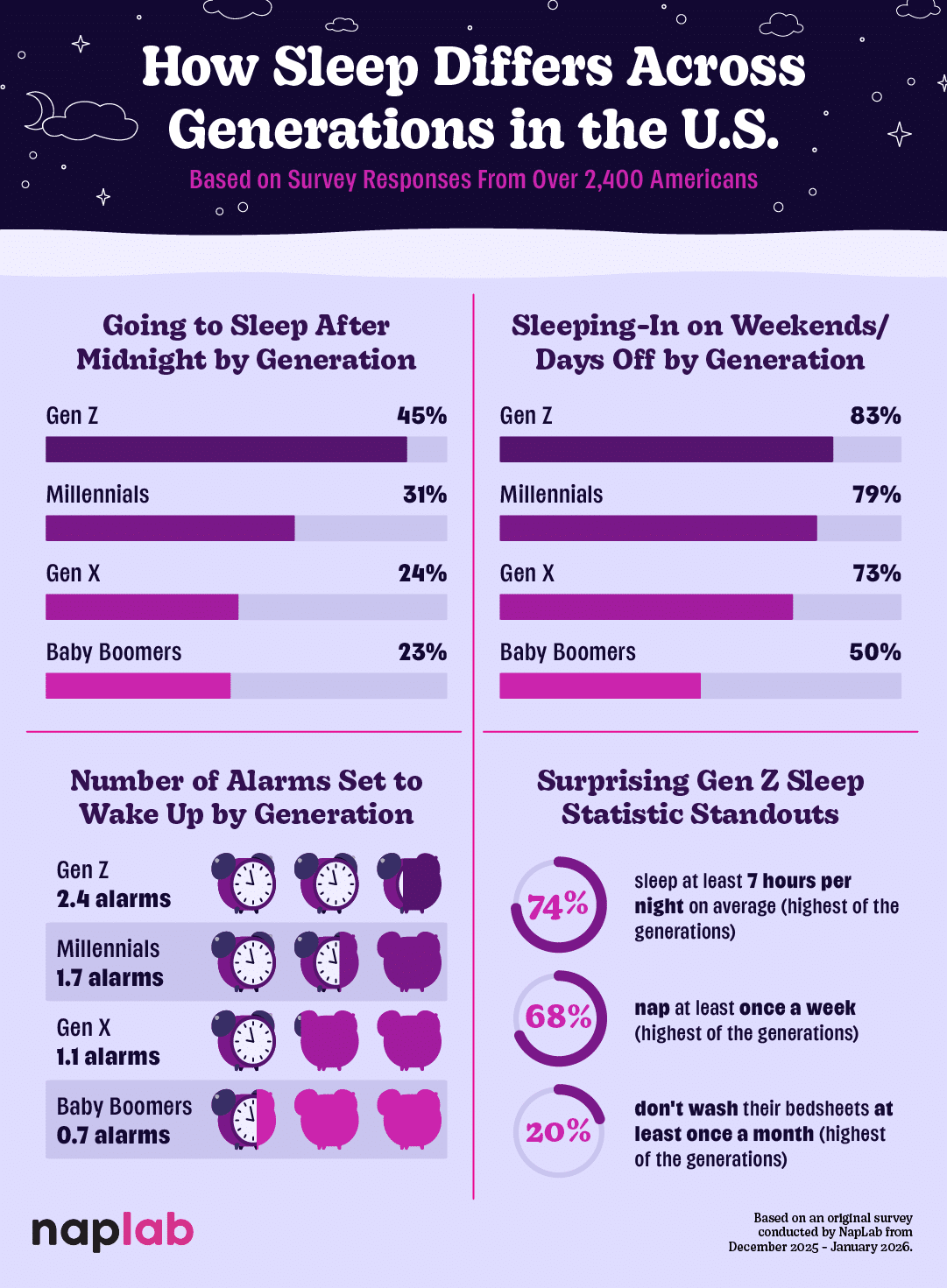
Based on our sleep survey data, sleep behaviors such as bedtimes, sleeping in, and alarm clock use steadily shift with age. Going to sleep after midnight is far more common among younger adults and drops with each older generation: 45% of Gen Z go to bed after midnight, compared to 31% of Millennials, 24% of Gen X, and 23% of Baby Boomers.
Sleeping In Becomes Less Common With Age
While most younger Americans sleep in on weekends to catch up on rest, that behavior declines as people age. The steepest drop (23%) occurs between Gen X and Baby Boomers, indicating retirement likely reduces the difference between weekday and weekend schedules.
- 83% of Gen Z sleep in on days off
- 79% of Millennials
- 73% of Gen X
- 50% of Baby Boomers
Older Generations Set Fewer Alarms
Each generation sets fewer alarms than the one before it, suggesting mornings become more predictable with age.
- Gen Z: 2.4 alarms on average
- Millennials: 1.7
- Gen X: 1.1
- Baby Boomers: 0.7
Gen Z Sleep Statistics
Despite later bedtimes and a heavier reliance on alarms, Gen Z posts some of the strongest sleep-related metrics:
- 74% sleep at least 7 hours per night (the highest share of any generation).
- 68% nap at least once a week.
- 20% do not wash their bedsheets at least once a month (the highest of any generation).
2026 Sleep Statistics: Men vs. Women
Who Sleeps More: Men or Women?
Men are more likely than women to fall short on sleep duration. Only 22% of American men sleep at least 8 hours per night on average, compared to 32% of women. Women are also twice as likely as men to get at least 9 hours of sleep.
Who Feels More Well-Rested?
Despite sleeping less, men report feeling more rested overall, averaging 4 days per week compared to 3 days for women.
Who Washes Their Sheets More Often?
36% of women wash their sheets at least once a week, compared to 27% of men. This means women are 33% more likely than men to wash their sheets at the recommended weekly frequency.
Bedtime Activities and Sleeping Nude
What Americans Do in Bed Before Sleeping
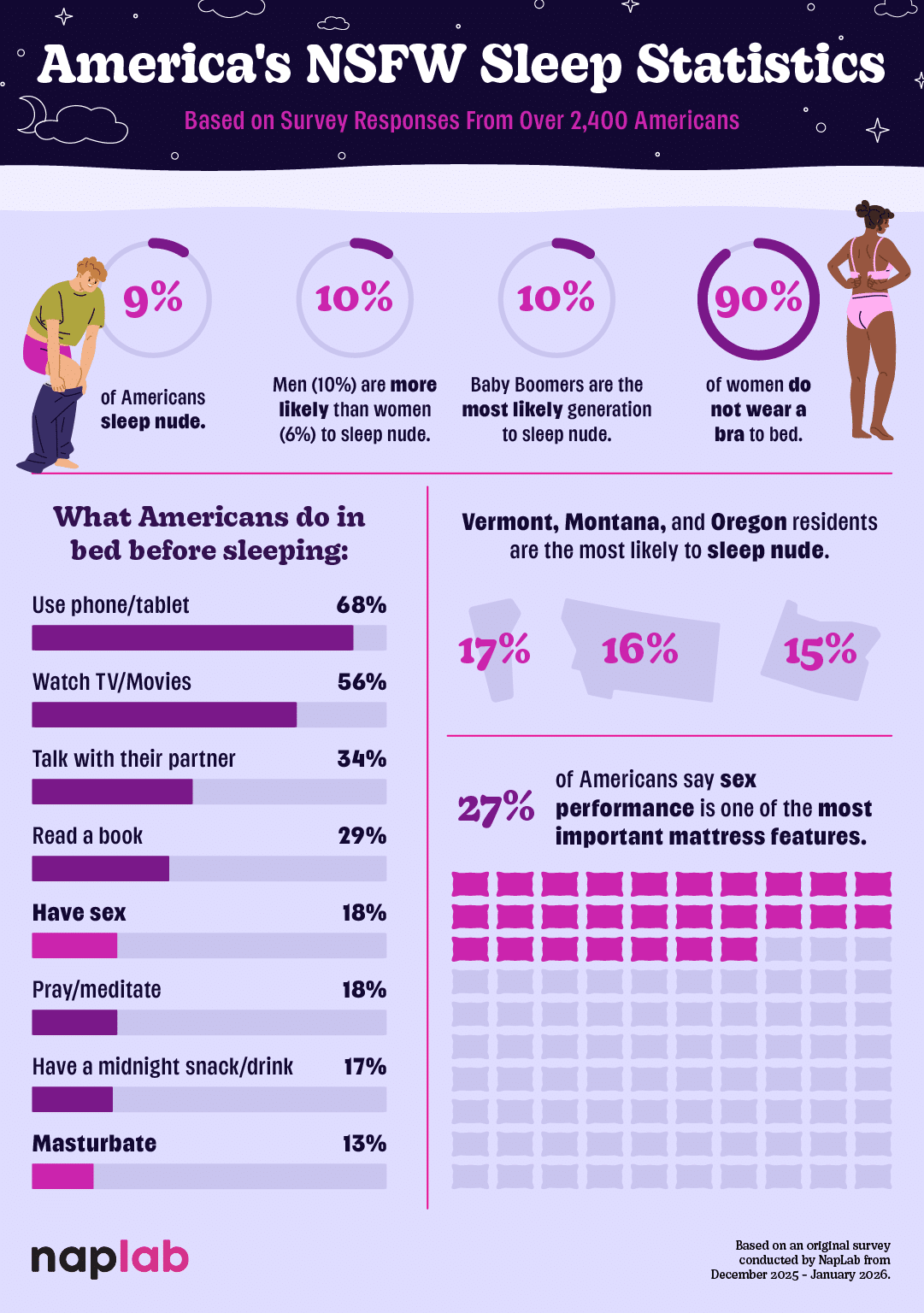
- 68% use a phone or tablet
- 56% watch TV or movies
- 34% talk with their partner
- 29% read a book
- 18% have sex
- 18% pray or meditate
- 17% have a midnight snack or drink
- 13% masturbate
Sleeping Nude
Overall, 9% of Americans report sleeping nude. Men (10%) are more likely than women (6%) to do so, and Baby Boomers are the generation most likely to sleep nude (10%). By state, Vermont (17%), Montana (16%), and Oregon (15%) have the highest shares. (See our sleeping nude guide).
American Mattress Preferences in 2026
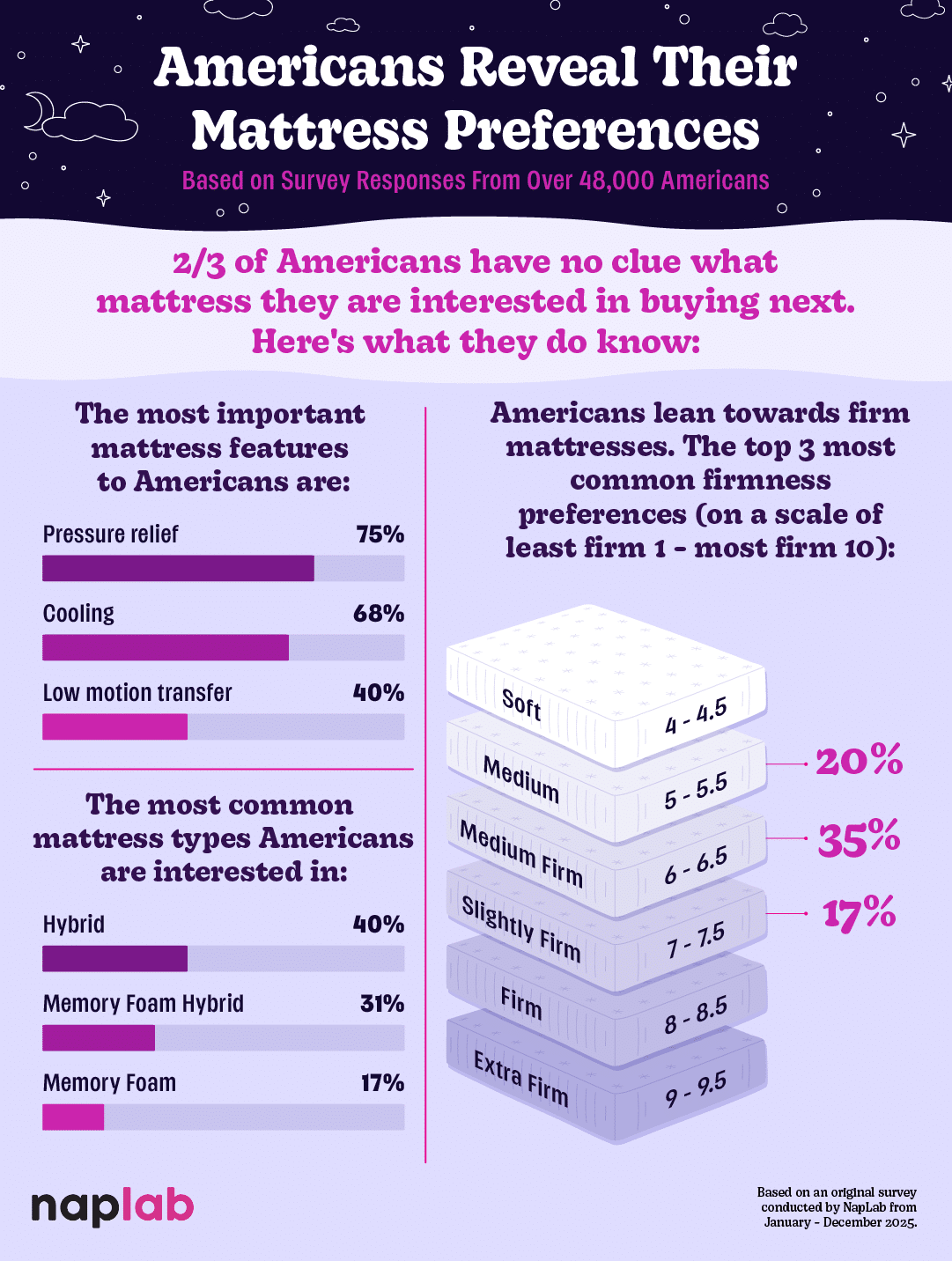
When it comes to buying a mattress, uncertainty is the norm; 66% of Americans say they do not know what kind of mattress they are interested in buying next.
The Mattress Characteristics That Matter Most
The most important mattress features to Americans are:
- Pressure relief (75%)
- Cooling (68%)
- Low motion transfer (40%)
- Sex performance (27%)
The most common firmness preferences (scale of 1-10) are Medium-firm (35%), Medium (20%), and Slightly firm (17%). Americans are most interested in Hybrid (40%), Memory foam hybrid (31%), and Memory foam (17%) mattresses.
“The mattress industry has spent decades trying to convince sleepers to spend more on increasingly complex mattresses and sleep products. But this data suggests that people are craving simplicity and a mattress that just works. The next step in sleep won’t be smarter beds, it’ll be about smarter boundaries.”
Derek Hales, Founder & Editor-in-Chief of NapLab.
Closing Thoughts
As Americans continue to juggle work, technology, and daily stressors, understanding how—and how well—we sleep becomes increasingly important. This report provides a clearer picture of where sleep in the U.S. stands today. Better sleep starts with better information, and NapLab’s guides are designed to help you build healthy habits and find the best mattress. If you’re ready to take the next step, take our quiz for a free personalized mattress recommendation.
Methodology
This study is based on an analysis conducted in January 2026 using responses from more than 50,000 U.S. adults across all 50 states. The dataset combines 48,000 responses from NapLab’s personalized mattress quiz with 2,400 responses from a nationally distributed survey fielded between December 2025 and January 2026.
Fair Use
You are welcome to use, reference, and share non-commercial excerpts of this study with proper attribution. If you cite our findings, please link back to this page so readers can view the full methodology, charts, and context.