At NapLab we use an industrial mattress testing machine called a rollator to conduct mattress durability tests. This machine uses a specially designed roller that simulates 10 years of tossing, turning, and use on a mattress.
This roller moves over the mattress 100,000 times in about 5 days. That rollator process shows us how well the foams, springs, and other materials hold up. Specifically, we can see if a mattress is sagging and if it gets softer with use.

In This Guide
Measurements | Importance | Durability Data | Testing Protocol | FAQs
What does a mattress rollator measure?
The rollator allows us to measure sagging and firmness before and after the 10 year accelerated use test.
Sagging is measured through height loss and increased sinkage depth. Height loss is simply how much height the mattress loses after the 10 year accelerated use test. We use a digitally controlled platen to take incredibly precise height measurements.
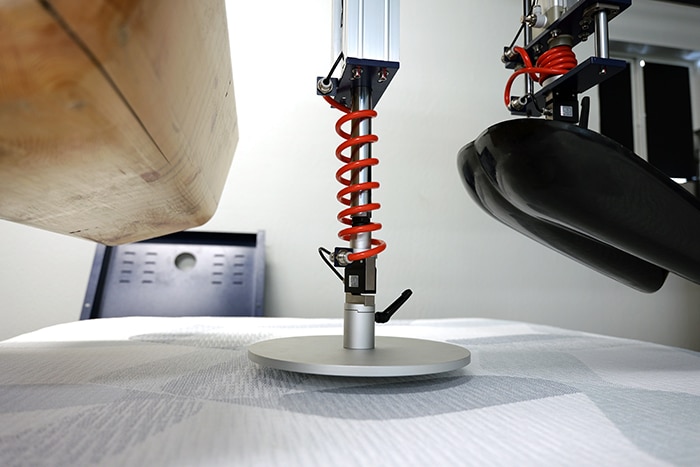
In addition, we also measure sinkage. To test for sinkage we press a platen into the mattress with a consistent, digitally controlled level of force. This provides us with a view into mattress resiliency and support before and after the roller test.
We also measure how much softer the mattress gets. We determine this measurement by using the same platen to apply a precise level of force, measure sinkage, and calculate a percentage of increased softness.
We gather the height, sinkage, and firmness measurements before performing the roller tests and then again after the roller test is finished to get a complete picture of mattress durability.
Why do these durability tests matter?
A mattress that sags over time is one of the top complaints you’ll find about mattresses. A mattress that sags isn’t as supportive, isn’t as comfortable, may cause pains and soreness, and simply doesn’t deliver great sleep.
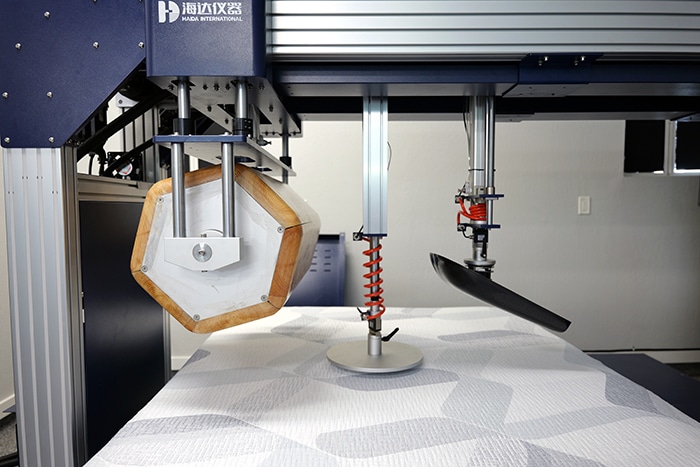
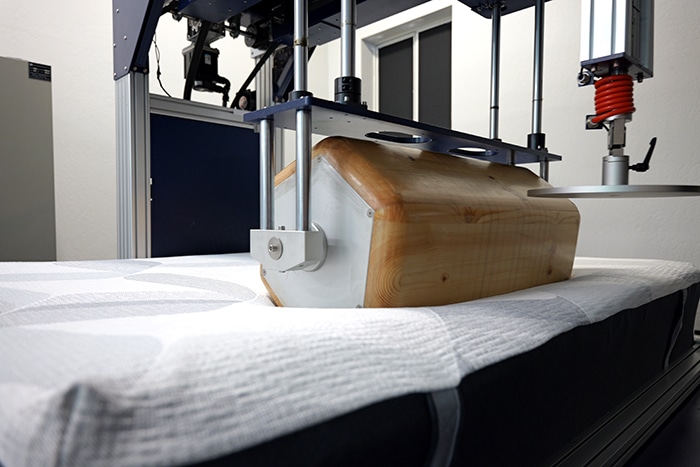
By measuring height, sinkage, and firmness before, letting the rollator cycle back and forth across the mattress 100,000 times, and then measuring the height, sinkage, and firmness again, we can determine how durable a mattress is, how much it sags, how support decreases (through the increased sinkage depth), and how much softer it gets.
Mattress Durability Testing Data
Below is a complete list of all mattress durability tests we’ve completed to date.
| Mattress Name | Durability Score | Height Loss % | Sinkage Gain % | Firmness Loss % | Review |
|---|---|---|---|---|---|
| Bear Elite Hybrid | 9.1 | 2.79% | -0.37% | -0.45% | Read Review |
| Beautyrest Black | 8.8 | 2.01% | 2.16% | 1.94% | Read Review |
| Brooklyn Bedding Copperflex | 9.4 | 1.24% | 0.87% | 0.72% | Read Review |
| Brooklyn Bedding Signature Hybrid | 8.9 | 3.42% | -1.55% | -1.55% | Read Review |
| Casper One | 9.3 | 0.34% | 2.21% | 2.40% | Read Review |
| Dreamcloud Hybrid | 9.0 | 1.34% | 2.24% | 2.28% | Read Review |
| Dreamcloud Luxe | 8.9 | 3.42% | -1.55% | -1.55% | Read Review |
| Dreamcloud Luxe Hybrid | 8.3 | 2.06% | 3.95% | 3.69% | Read Review |
| GhostBed Luxe Foam | 6.5 | 2.21% | 10.92% | 9.82% | Read Review |
| Leesa Sapira | 8.9 | 2.65% | 0.73% | 0.73% | Read Review |
| NapQueen | 5.4 | 1.85% | 15.64% | 13.64% | Read Review |
| Nectar Hybrid | 9.4 | 0.63% | 1.60% | 1.55% | Read Review |
| Purple Restore Plus | 7.6 | 3.89% | 4.14% | 3.97% | Read Review |
| Saatva Classic | 9.3 | 2.21% | -0.87% | -0.94% | Read Review |
| Sealy Posturepedic Plus Prosser Hills | 8.4 | 1.83% | 3.86% | 3.61% | Read Review |
| Tempurpedic Luxe Breeze | 9.0 | 1.75% | 1.38% | 1.46% | Read Review |
| Tempurpedic Supreme Hybrid | 9.8 | 0.26% | 0.39% | 0.16% | Read Review |
| WinkBed | 8.1 | 2.24% | 4.34% | 4.19% | Read Review |
| Zenhaven | 7.4 | 3.39% | 5.65% | 5.33% | Read Review |
Testing Process & Protocols
We will be using the ASTM testing standard for mattresses. ASTM is a non-profit international organization that develops testing standards designed to improve quality, safety, and performance for products, materials, and more. They operate across numerous industries. Virtually every major mattress brand in the US uses the ASTM F1566 testing standard to test their mattresses for durability.
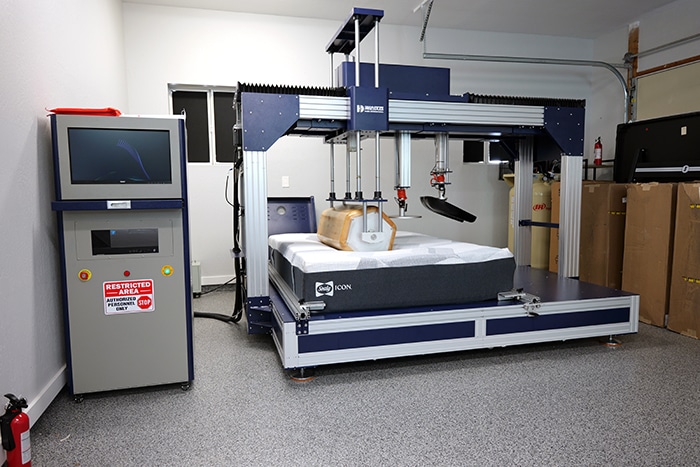
The F1566 standard has a laundry list of requirements and protocols to be followed and we do our best to follow them to the letter of the law. However, there are some that we are unfortunately unable (or are choosing not) to follow. Due to the way ASTM aggressively defends their copyright we are not able to discuss the specific requirements that we’re not following.
While I don’t think ASTM would sue us for talking about those requirements, I’m also not 100% certain that they would not. In any case, I don’t believe any of the F1566 requirements that we’re not doing will meaningfully impact the results.
NapLab is not endorsed by, certified by, or otherwise affiliated with ASTM in any way.
Testing Process
Our testing process includes the following steps:
- Measure the height of the mattress
- Measure the hardness (aka firmness) of the mattress
- Run a rollator (the larger wooden roller) 100,000 times across the middle of the mattress (a process which takes around 5 days). This simulates 10 years of use on the mattress.
- Measure the height of the mattress
- Measure the hardness of the mattress
The primary data points we collect and analyze include:
- Height Loss – This is how much height a mattress loses after the accelerated 10 year test. We measure height loss as an absolute number and a percentage of height loss. Mattresses with less height loss are better.
- Sinkage Gain – This is how much sinkage into the mattress is allowed using a consistent force level (778N). We measure sinkage gain as an absolute number and a percentage of sinkage change. Mattresses with less sinkage gain are better.
- Firmness Loss – This is how much softer the mattress is after the accelerated 10 year test. We measure firmness loss as a quotient (778N divided by sinkage depth in mm) and as a percentage of firmness loss. Mattresses with less firmness loss are better.
Scoring Parameters
Our durability score is a weighted score. 33.33% of the score comes from height loss, 33.33% of the score comes from sinkage gain, and 33.33% of the score comes from firmness loss.

Here’s the scale we use to determine the height loss score:
10
height loss % ≤ 0.05 %
9.0 – 9.9
0.05 % < height loss % ≤ 1.05 %
8.0 – 8.9
1.05 % < height loss % ≤ 2.05 %
7.0 – 7.9
2.05 % < height loss % ≤ 3.05 %
6.0 – 6.9
3.05 % < height loss % ≤ 4.05 %
5.0 – 5.9
4.05 % < height loss % ≤ 5.05 %
4.0 – 4.9
5.05 % < height loss % ≤ 6.05 %
Linear Function
f(x) = -100x + 10
What It Means
For every 1 percent above 0 percent(s), 1 point is deducted from the value.
Here’s the scale we use to determine the sinkage gain score:
10
sinkage gain % ≤ 0.125 %
9.0 – 9.9
0.125 % < sinkage gain % ≤ 2.625 %
8.0 – 8.9
2.625 % < sinkage gain % ≤ 5.125 %
7.0 – 7.9
5.125 % < sinkage gain % ≤ 7.625 %
6.0 – 6.9
7.625 % < sinkage gain % ≤ 10.125 %
5.0 – 5.9
10.125 % < sinkage gain % ≤ 12.625 %
4.0 – 4.9
12.625 % < sinkage gain % ≤ 15.125 %
Linear Function
f(x) = -40x + 10
What It Means
For every 1 percent above 0 percent(s), 0.4 points are deducted from the value.
And here’s the scale we use to determine the firmness loss score:
10
firmness loss % ≤ 0.125 %
9.0 – 9.9
0.125 % < firmness loss % ≤ 2.625 %
8.0 – 8.9
2.625 % < firmness loss % ≤ 5.125 %
7.0 – 7.9
5.125 % < firmness loss % ≤ 7.625 %
6.0 – 6.9
7.625 % < firmness loss % ≤ 10.125 %
5.0 – 5.9
10.125 % < firmness loss % ≤ 12.625 %
4.0 – 4.9
12.625 % < firmness loss % ≤ 15.125 %
Linear Function
f(x) = -40x + 10
What It Means
For every 1 percent above 0 percent(s), 0.4 points are deducted from the value.
Frequently Asked Questions
Why does your data say a mattress doesn’t sag when other people say it does?
Our durability tests are conducted under controlled and precise testing conditions, including testing on a solid aluminum surface with no gaps and no slats. Many mattress frames / foundations simply do not provide sufficient support to the mattress. When this happens a mattress can see considerably more sagging, dips, body impressions, and permanent deformations in the mattress.
In addition, many sleepers choose not to use a waterproof mattress protector, which also degrades mattress longevity. A typical adult loses 0.5 to 1.0 liter of fluid each night while they sleep. That fluid loss occurs due to breathing and sweating. In addition, oils from skin and hair can also be lost during the night. If you do not use a waterproof mattress protector some of the liquid can get into the mattress. Over time, that liquid will work to significantly break down the foams and other materials, causing sagging, dips, body impressions, and permanent deformations in the mattress.
What can I do to prevent and reduce sagging, dips, and body impressions in the mattress?
First, use a high performance mattress frame / foundation. A high quality frame / foundation provides better support to the mattress, which reduces the sagging and body impressions. The ideal frame / foundation is a solid surface with no gaps. If you do opt for a slatted frame / foundation, ensure the slats are at least 3″ wide, gaps of no more than 3″, slats are rigid (not flexible or bowed), slats are thick (ideally 0.5″ or thicker), and there is a central support beam in the middle.
In addition, any frame should have at least 5 supporting legs, but more is better. More legs ensures a more stable and complete support, which will help to improve longevity and reduce sagging.
Second, use a high performance waterproof mattress protector. A waterproof protector prevents liquid, skin oils, dirt, dust, and other debris from making contact and entering the mattress. The liquids and other contaminants will work to break down the materials in the mattress if not stopped by a waterproof mattress protector.
What bed frames and foundations help to create the best mattress longevity?
The best bed frame and foundation I’ve seen is the Sleeping Duck Indestruct. This frame foundation combo meets and exceeds all of the ideal requirements to prevent and reduce mattress sagging. It has a solid end-to-end surface, while still providing aeration holes for breathability. In addition, we have 6 supporting feet, a full steel support structure, and two supporting steel beams across the middle. It’s expensive, but it’s also an incredibly high performance, high quality frame.
Floyd Bed is another great choice. It’s a solid platform frame foundation combo with end-to-end solid support that is thick, rigid, and incredibly supportive. This is the frame that we use for all mattress testing at NapLab and it’s also the frame I use for personal use.
Winkbed’s Platform Foundation and Amerisleep’s Platform Bed Frame are also good options. While these do use a slat support structure, the slats are rigid, wide, no flex, thick, and there is a central supporting beam. Amerisleep’s frame has 6 legs and Winkbed’s has an impressive 9 legs. These are also both considerably less expensive than the Sleeping Duck Indestruct.
What mattress protectors do you recommend?
The best mattress protector I’ve tested to date is the Bedgear Dri Tech Performance. It’s not cheap, but it’s incredibly breathable, cool, and stretchy, while also being waterproof. This protector won’t get in the way of the mattress cooling performance or feel, which many cheaper mattress protectors will.
Another good option is the SLEEP TITE. Its cooling performance isn’t quite as good, but it’s also considerably less expensive than the Bedgear while still providing the required waterproof protection for the mattress.
I have been using both of these protectors for personal use for nearly a decade. They have held up incredibly well over the years.