Memory foam has traditionally been a favorite material for sleepers who enjoy a more dramatic body contour, deeper hug, and lower motion transfer. Hybrids entered the market as a good option for sleepers looking for faster material response time and better cooling, but with the comfort of foam layers. Memory foam hybrids were born as a compromise between these two types, featuring a memory foam comfort layer and coil support.
Which type is best for you? Let’s dive into this guide and find out how they’re similar, how they’re different, and which mattress type may work best for you.
In This Comparison
Best Models | Comparison | Memory Foam | Hybrids | Memory Foam Hybrids | Summary | FAQ
| Mattress Type | Best For | Average Price | Average Performance |
|---|---|---|---|
| Memory Foam | Deeper contour and low motion transfer | $1,129 | 8.10 |
| Hybrid | Better support, balanced, even, non-polarizing feel | $1,529 | 8.63 |
| Memory Foam Hybrid | Contour of memory foam + fast response from the coil base | $1,825 | 8.77 |
Best Memory Foam
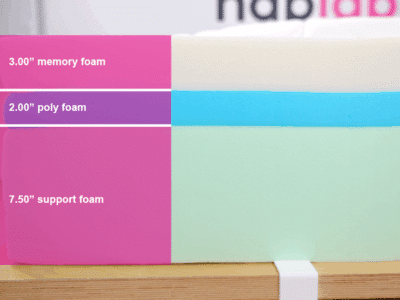
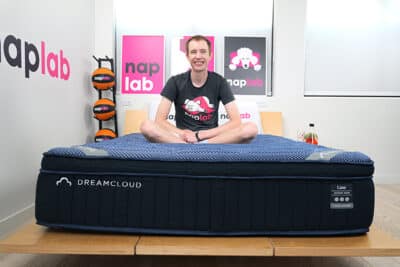
DreamCloud Luxe
The DreamCloud Luxe is the best memory foam mattress tested to date with a medium-firm feel (6 out of 10). It has a thick 3.0″ memory foam comfort layer, while still scoring a fast response time.
Best Hybrid
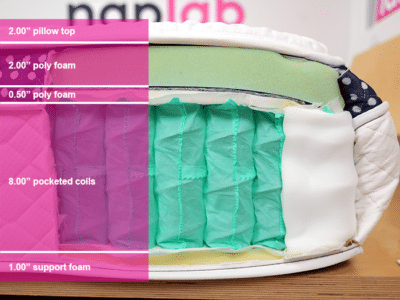
WinkBed
For a blend of poly foam and pocketed coils, it doesn’t get better than the WinkBed hybrid. This mattress has a 5.0″ comfort layer and is the #1 best-scoring mattress that we’ve tested to date.
Best Memory Foam Hybrid
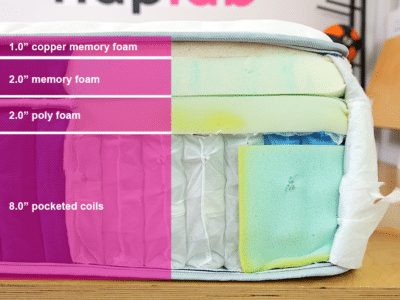
Glacier Apex
For a memory foam feel with the support of a hybrid, the Glacier Apex is our top pick. It is 14.25″ thick with a medium-firm feel (6 out of 10), moderate sinkage, and low levels of bounce.
Memory Foam vs. Hybrid—Which is Better?
We conduct data-driven and objective tests for every mattress we review (see how we test here). Each mattress has 64 individual data points that are recorded and analyzed.
The comparison chart below looks at the average performance for each category based on all relevant mattresses we have tested to date.
| Testing Factors | Hybrids | Memory Foam Hybrids | Memory Foam | Average Mattress |
|---|---|---|---|---|
| Top Picks | Best Hybrid Mattresses | Best Memory Foam Hybrids | Best Memory Foam Mattresses | Best Mattresses (All) |
| Average Price (Queen) | $1,529 | $1,825 | $1,129 | $1,523 |
| Overall Score | 8.63 | 8.77 | 8.10 | 8.52 |
| Cooling | 8.7 | 9.2 | 7.9 | 8.6 |
| Motion Transfer | 8.3 | 8.6 | 8.6 | 8.2 |
| Response Time | 8.6 | 7.9 | 7.6 | 8.7 |
| Edge Support | 8.9 | 8.8 | 8.1 | 8.7 |
| Sex | 8.5 | 7.7 | 7.0 | 8.2 |
| Pressure Relief | 8.7 | 9.5 | 8.4 | 8.6 |
| Off-Gassing | 7.9 | 7.8 | 7.7 | 7.9 |
| Company | 8.9 | 9.1 | 8.9 | 8.8 |
| Sinkage | 2.32″ | 2.29″ | 2.15″ | 2.22″ |
| Bounce | 9.47″ | 7.89″ | 6.12″ | 8.80″ |
What mattress is best for whom? It depends on what you’re looking for. The table below highlights the best mattress type for each category.
| Best For | Winner |
|---|---|
| Overall Performance | Memory Foam Hybrids |
| Best for Cooling | Memory Foam Hybrids |
| Lowest Motion Transfer | Memory Foam |
| Fastest Response Time | Hybrids |
| Best Edge Support | Hybrids |
| Best for Sex | Hybrids |
| Best for Pressure Relief | Memory Foam Hybrids |
| Best for Off-Gassing | Hybrids |
| Best Company Score | Memory Foam Hybrids |
| Best for Balanced Feel | Hybrids |
| Best for Less Sinkage | Memory Foam |
| Best for More Sinkage | Hybrids |
| Best for Low Bounce | Memory Foam |
| Best for High Bounce | Hybrids |
| Best for Budgets (lowest average price) | Memory Foam |
What is Memory Foam?
Memory foam is a man-made foam created from the combination of polyurethane and other chemicals that create a high level of contour and hug as you lie on the mattress. You’ll sometimes see memory foam labeled as viscoelastic polyurethane foam.
It is the viscoelasticity that makes memory foam memory foam. That’s what gives it the unique hug and body contouring.
What does memory foam feel like?
The feel of memory foam is marked by deeper contouring and hug around the body. Memory foam forms itself around the contours of your body as you sleep, designed for better pressure relief and spinal support.
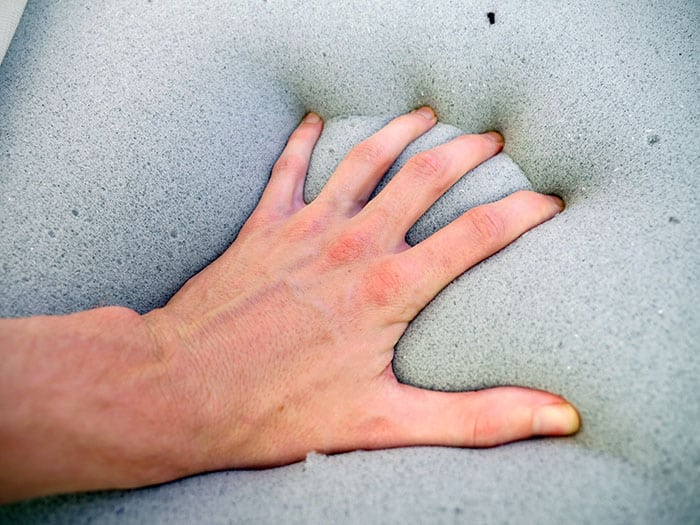
You know the visual of the hand being pressed into the mattress? And when it is removed, the handprint remains? That is traditional memory foam.
Advantages of Memory Foam
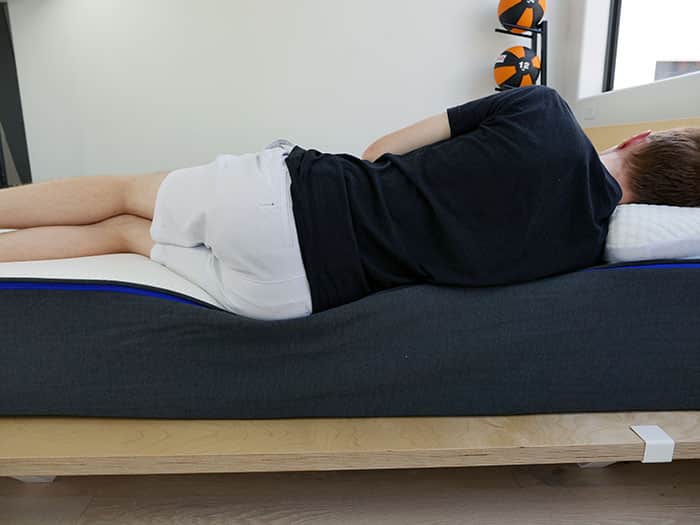
#1. Deeper Hug
If you like the feeling of your mattress hugging you, memory foam is a great choice. Especially for side sleepers, this deeper hug helps to relieve pressure points along your hips, spine, and shoulders.
#2. Minimal Motion Transfer
Because traditional memory foam has a denser feel, motion is absorbed into the foam instead of reverberating back (like you may experience on a coil mattress). This can be a real advantage for sensitive sleepers or those who are easily disturbed by partners who toss and turn.
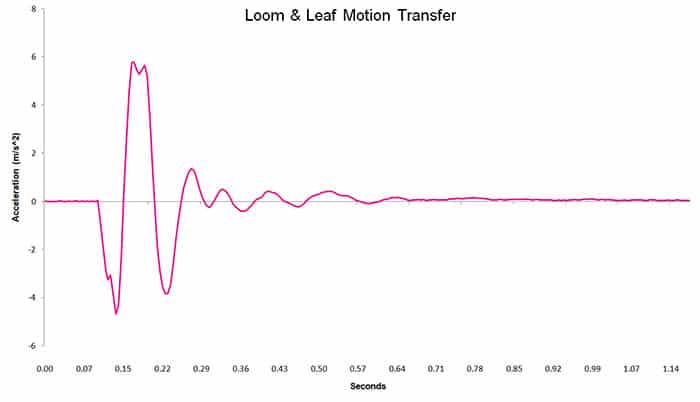
The chart above shows motion transfer in our test of the Loom & Leaf, a luxury memory foam mattress. As you can see, there is an initial energy spike from where the ball was dropped in our tests, but that energy dissipated very fast.
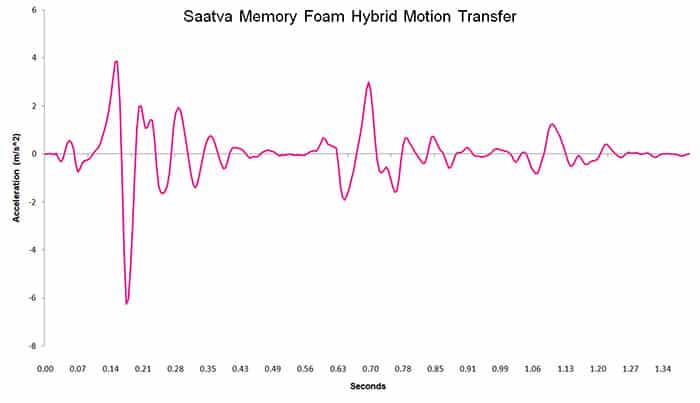
For comparison, here is a similar motion transfer chart on the Saatva memory foam hybrid, which uses memory foam and coils. As you can see, it’s a more significant energy spike and the energy continues to bounce across the mattress for over 1 full second.
Disadvantages of Memory Foam
#1. Heat Retention
Traditional memory foams sometimes struggle with heat retention. When body heat gets trapped in memory foam, it can be hard for that heat to dissipate through the mattress. This is just the nature of many viscoelastic poly foams.
Some memory foams try to counteract this by having an open-cell structure or by including additives in the foam like cooling gel or a copper-infused composition.
#2. Worse Edge Support
Memory foam can sometimes create worse edge support, as foam tends to allow for more compression.
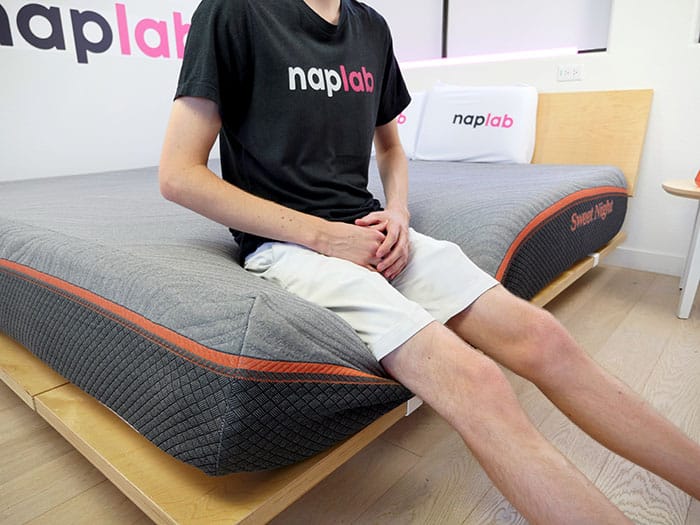
Among all memory foam mattresses we’ve tested to date, we do see a range of performance. Even though many memory foam mattresses struggle in this area, not all do.
Some mattresses have reinforced edges, which help counteract that compression, or thinner comfort layers. For example, the organic BedInABox EcoLux, the Ghostbed Luxe, or the Novosbed mattress all had excellent edge performance with scores in the mid to upper 9’s.
What is a Hybrid?
A hybrid mattress is any mattress where the layers are made up a blend of various foams and coils.
Most hybrid mattresses utilize a layer of pocketed coils (usually 6-8″) that is sometimes reinforced with a thin (usually 1″) layer of support foam on the base.
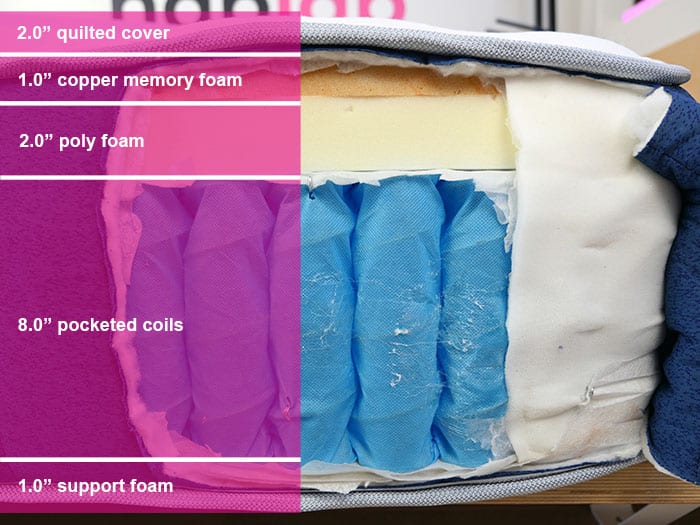
The comfort foam on top usually ranges from 2-6″ of material and can include memory foam, latex foam, poly foam, natural materials, and other types of comfort materials.
What does a hybrid mattress feel like?
Hybrids are designed to take the best of foam mattresses as well as coil mattresses. They tend to have the compression and feel of a foam mattress, but the support coils below provide some pushback for support and pressure relief in the lower layers.
It’s a balanced feel that is active and engaging from coils, while maintaining the deeper hug and contour that foam often provides.
Advantages of a Hybrid Mattress
#1. Better Ease of Movement
Many times, foam mattresses can have a slower material recovery speed, which can make them more difficult to move around on and change positions. A hybrid integrates coils, which can provide a faster response while maintaining the pressure relief and comfort of foam comfort layers.
#2. Improved Edge Support
Edge support is another area that gets a boost in performance when switching from strictly memory foam to a hybrid. Foam at the edge has a tendency to compress easily and leave you feeling unsupported when sitting at the edge.
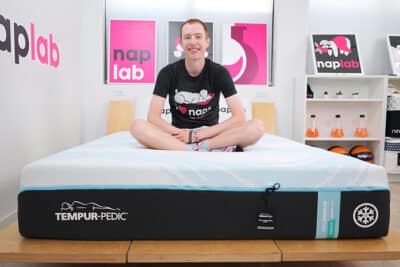
On a hybrid, coils can be used for additional edge support and reinforcement. Check out the difference of sitting edge sinkage below between Tempurpedic Supreme (all foam) and Tempurpedic Supreme Hybrid.


As you can see, edge compression is significantly deeper on the all-foam Tempurpedic Supreme. Even when foam layers were incredibly similar, simply adding coils to the Tempurpedic Supreme Hybrid greatly improved performance.
Disadvantages of A Hybrid Mattress
#1. More Motion Transfer + Bounce
It’s no surprise that coils provide more energy than memory foam. While that energy oftentimes means faster material recovery speed, it can also mean higher levels of motion transfer and higher levels of bounce.
Bounce is a bit of a preferential factor, but not all sleepers are looking for higher levels of bounce, so it may be something to consider.
#2. Higher Profile
A quality hybrid mattress will oftentimes be a bit thicker than all-foam mattresses. If you don’t prefer the taller aesthetic, this could be something to consider when choosing between the two styles.
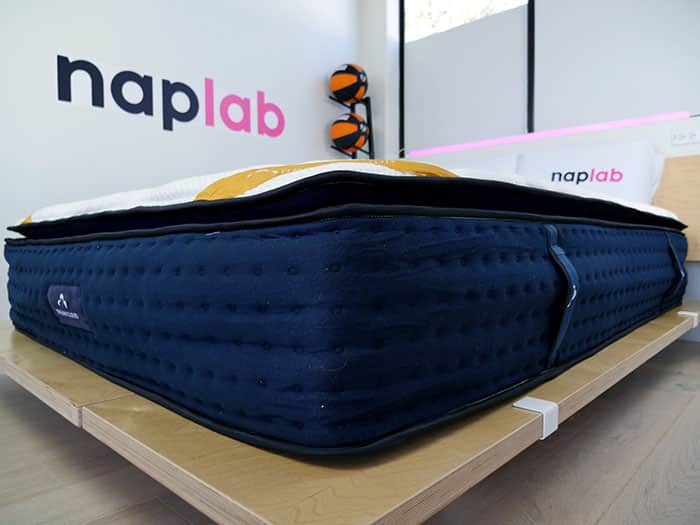
The average hybrid is 12.9″ thick, whereas the average memory foam mattress is 11.9″ thick, a difference of a full inch.
What is a Memory Foam Hybrid?
A memory foam hybrid mattress can be a great compromise for sleepers who want the feel of memory foam but the support of a hybrid.
The comfort layer has a distinctive memory foam feel, and the support base typically uses pocketed coils (usually 6-8″) that are sometimes reinforced with a thin (usually 1″) layer of support foam.
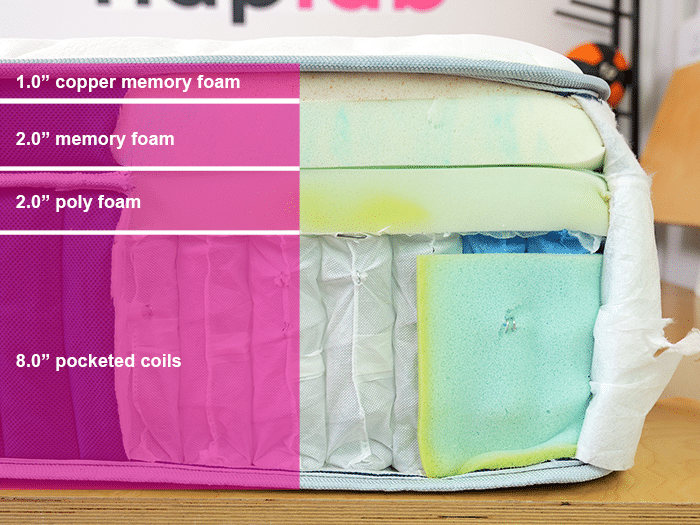
Like other hybrids, the comfort foam on top usually ranges from 2-6″ of material. While memory foam hybrids can still contain a blend of foams (most commonly memory foam and poly foams), the memory foam layer will almost always be on the top.
This gives the mattress the feel of more traditional memory foam, but without the disadvantages (higher heat retention and slower response time).
What does a memory foam hybrid mattress feel like?
The feel of a memory foam hybrid will be a nice mix of memory foam and hybrid mattresses. These options tend to have the dramatic body contour of memory foam, giving the feel of the comfort materials hugging you.
The hug will likely be more dramatic than what you’d experience with a regular hybrid that does not contain memory foam.
But because of the support coils, the foams tend to be more responsive and there is more bounce than what you’d experience with an all-memory foam mattress.
Advantages of a Memory Foam Hybrid Mattress
#1. Better Cooling
In our tests, memory foam hybrid mattresses have the highest average cooling score (9.2) compared to regular hybrids or all-foam models. As mentioned above, cooling can be one of the biggest disadvantages of traditional memory foam. In our tests, all-foam memory foam mattresses earn an average cooling score of only 7.9.
#2. Exceptional Pressure Relief
Pressure relief is another area where memory foam hybrids really excel. In our tests, the average pressure relief score for memory foam hybrids is 9.5, notably higher than all other options in this comparison. Memory foam is known to improve pressure relief as it allows for a more dramatic body contour that can hug sensitive areas.
Disadvantages of A Memory Foam Hybrid Mattress
#1. Price
The price may be the biggest disadvantage of memory foam hybrids, coming in at $1,891 for the average memory foam hybrid (queen). This is over $350 more expensive than the average mattress and nearly $800 more than the average memory foam mattress.
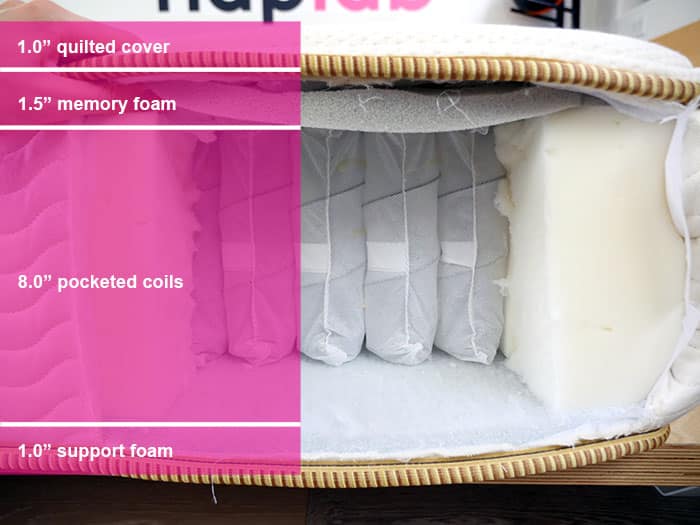
The pocketed coil base is certainly a large contributing factor to the higher price, but it’s also the reason why performance is also the highest among all types in this comparison.
#2. Worse Sex Performance
A worse sex performance is the other largest disadvantage of memory foam hybrids. Since the memory foam comfort layer provides more contour and hug, that also means it has less bounce. And less bounce tends to kill energy on the mattress surface, making intimacy more strenuous and tiring.
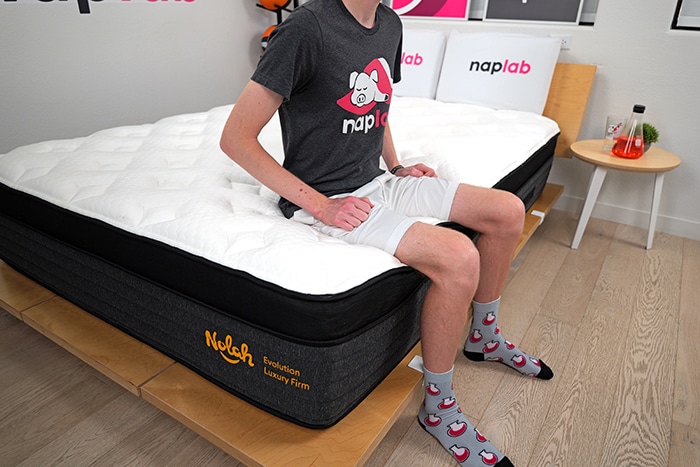
That said, the score on memory foam hybrids (7.7) is still notably higher than the average memory foam score (7.0).
And it’s also important to note that not all memory foam hybrids will struggle with this. While the Glacier Apex, Nolah Evolution, and Leesa Reserve all have below-average sex scores, the Saatva Memory Foam Hybrid, Amerisleep AS5, and Brooklyn Bedding CopperFlex Pro Hybrid all have sex scores that performed better than average.
So as with any of these categorical pros and cons, there are always exceptions to the rule.
Which is right for you?
So you’ve made it this far… how do you know which mattress is right for you?
Memory foam mattresses are better if you’re looking for:
- More hug and contour
- Less bounce
- Minimal noise
- Less motion transfer
Best Memory Foam Mattresses
Top Picks
Hybrid mattresses are better if you’re looking for:
- Better cooling
- Faster response time
- Better edge support
- Better sex
Best Hybrid Mattresses
Top Picks
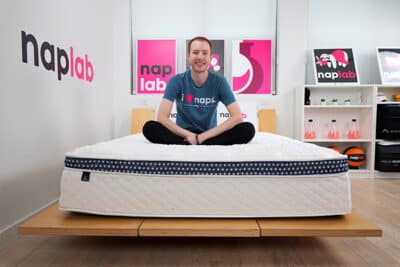

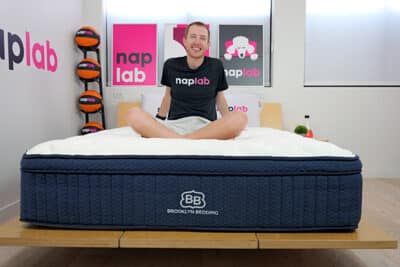
Memory foam hybrid mattresses are better if you’re looking for:
- Dramatic contour
- Better pressure relief
- Limited heat retention
- Less bounce
Best Memory Foam Hybrids

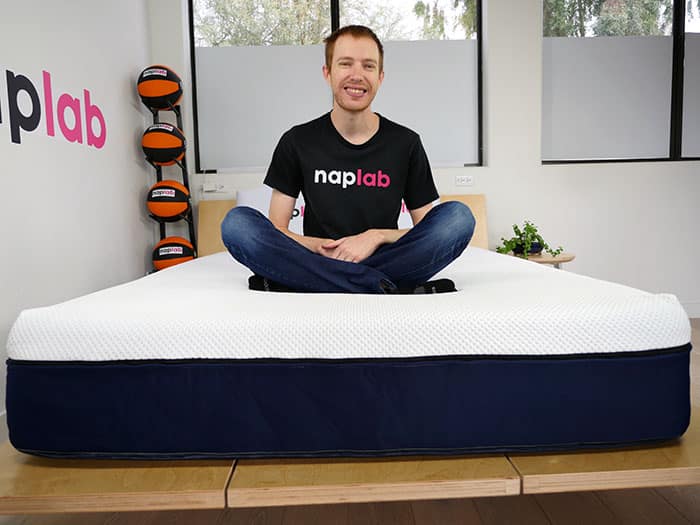
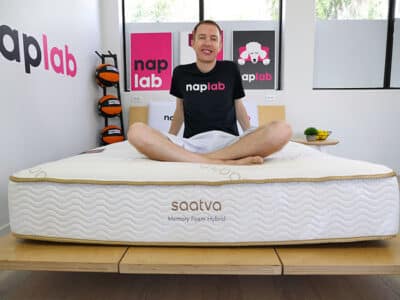
FAQs
Which is better—memory foam or hybrid?
It depends on what you’re looking for. For compression, hug, contour, and less motion transfer, memory foam is the best option. But if you’re looking for faster response, better edge support, better cooling, better sex, and more of a balanced feel, a hybrid is the better pick. Memory foam hybrids hit the sweet spot right in the middle
Which lasts longer—memory foam or hybrid?
Most quality memory foam and hybrid mattresses should last 8-10 years. All that being said, the exact lifespan of any mattress depends on who is sleeping on it, foundational support, mattress quality, mattress care (ex. rotating, mattress protector), and other environmental factors.
Which is softer—memory foam or hybrid?
Firmness is not determined by mattress type. There are ultra soft and ultra firm memory foam and hybrid mattresses, and every firmness in between.
Are hybrid mattresses more expensive than memory foam?
On average (based on our tests), hybrid mattresses are more expensive than memory foam mattresses. That said, there are both very cheap and very expensive versions of both mattress types. The price is highly dependent on the specific materials, brand, thickness, specialized features, purchase location (online vs. in-store), and other factors.
Do hybrid mattresses squeak?
Typically, no, but the amount of noise created by a hybrid mattress can vary. This is especially true for hybrids that use lower quality coil units. A low quality hybrid mattress may squeak or one that does not have enough material between the coils and the sleeper. Pocketing coils or wrapping them in foam are two good ways manufacturers can limit squeaky coils.
Do you need a boxspring with a hybrid mattress?
Typically, no, you do not need a boxspring with a hybrid mattress. The vast majority of hybrid mattresses require a a foundation, slats, platform, bunkie board, or adjustable base. A traditional box spring with actual steel springs is generally not an acceptable foundation and will not provide appropriate support to the hybrid mattress. Using a traditional box spring with a hybrid mattress will often void your warranty.