
Best For
- Excellent edge support
- Relatively inexpensive at C$719
- 365-night trial period
Considerations
- Significantly below average performance
- Higher levels of motion transfer
- Disappointing sex score, largely due to low bounce levels
Our Verdict
The Emma Body Adapt is a 9.50″ foam mattress made of poly foam, memory foam, and support foam. There are no coils and the Emma has a simple design.
The Emma Body Adapt is available in a single firmness level — medium-firm. In our tests, this had a rating of 6 out of 10, where 10 is the most firm.
This mattress has moderate sinkage and low levels of bounce, giving the mattress a balanced feel. It has a slight body contouring hug, which could be good for sleepers who don’t like a lot of hug from their mattress.
In our performance tests, this mattress earned an overall score of 7.69, ranking the mattress in the bottom 13% of all mattresses tested to date.
The Emma Body Adapt is C$719 for a queen-sized mattress, which is a relatively low price point. Even so, the overall performance of this mattress leaves much to be desired. As a result, it’s just not one I would strongly recommend.
Type: Foam
Firmness: Medium-Firm (6)
Best For: All Sleeping Positions, All Body Weights
In This Review
Performance Tests | Firmness | Support & Sleeping Positions | Design | Materials | Comparisons | FAQs
Performance Tests
At NapLab, we put each mattress to the test.
We test 10 different factors that impact the performance, comfort, and feel of the mattress. We then take the results of those tests and compare them to every mattress we’ve tested to date.
Check out the full performance table below to see how this mattress ranks:
| Factor | Emma Body Adapt | Average |
|---|---|---|
| Overall Score | 7.69 | 8.52 |
| Price (Queen) | C$719 | $1,113 (Foam only) |
| Cooling – Score | 8.0 | 8.6 |
| Sinkage – Depth | 2.05″ | 2.25″ |
| Sinkage – Feel | Moderate | Moderate |
| Motion Transfer – Score | 6.8 | 8.2 |
| Motion Transfer – Acceleration | 12.16 m/s² | 8.80 m/s² |
| Response Time – Score | 7.5 | 8.8 |
| Response Time – Mostly Recovered | 0.6 sec. | 0.4 sec. |
| Response Time – Fully Recovered | 1.2 sec. | 1.0 sec. |
| Bounce – Height | 6.63″ | 8.67″ |
| Bounce – Feel | Low | Moderate |
| Edge Support – Score | 9.2 | 8.7 |
| Edge Support – Sitting | 3.50″ | 3.85″ |
| Edge Support – Lying | Excellent | Good |
| Sex – Score | 7.5 | 8.2 |
| Pressure Relief – Score | 8.0 | 8.6 |
| Comfort Layer Thickness | 3.50″ | 4.34″ |
| Mattress Thickness | 9.50″ | 12.29″ |
| Off-Gassing – Score | 1.7 | 7.9 |
| Off-Gassing – Smell | Strong | Strong |
| Off-Gassing – Days | 30 days | 8 days |
| Company – Score | 9.6 | 8.8 |
| Trial | 365 nights | 191 nights |
| Warranty | 15 years | 40% have lifetime warranties, average of other 60% of mattresses is 13 years |
How is Emma Body Adapt Different?
The Emma Body Adapt is a 9.50″ foam mattress with an overall performance level that is significantly below the average score, but it does have a reasonable price. Even so, it’s hard to recommend a mattress that earned a score in the bottom 13% among all mattresses we’ve tested (regardless of price point).
Advantages
All that said, there are still a few categories that the Emma does perform above average. First, the edge support is impressive for a foam mattress. Also, it comes with a 365-night trial and 15-year warranty, which are both longer than average.
Neutral Factors
The Emma has moderate sinkage and low bounce. These two factors are considered neutral since different sleepers will have different preferences. Overall, the Emma has a balanced feel and a slight contour.
If you want a mattress that “hugs” you, this may not be the best option for you.
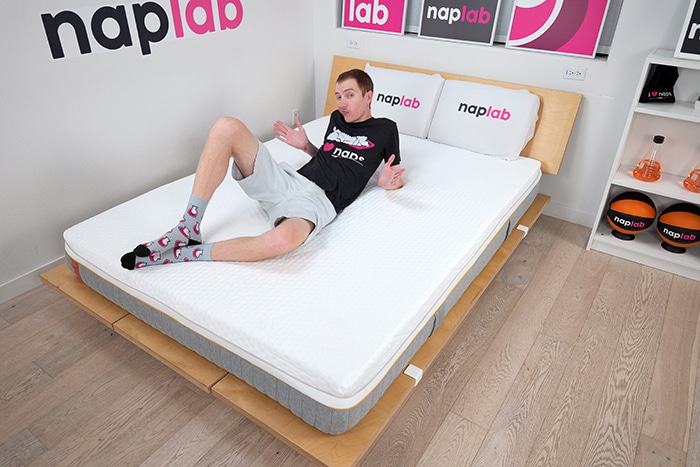
Disadvantages
There are many disadvantages to the Emma Body Adapt mattress, including below-average cooling, higher levels of motion transfer, slower material response time, a lower sex score, and worse pressure relief as well.
This mattress only has a 3.5″ comfort layer, where 4.3″ is the average thickness. Lastly, the mattress has strong off-gassing right out of the box and the smell lingered for 30 days in our tests, which is significantly longer than the average we’ve tested.
Cooling Test
The Emma Body Adapt has good cooling. During our tests, I felt a slight level of heat retention around my body, but fortunately it was nothing extreme or anything I would describe as “hot”.
Baseline Temp.
76.2° F
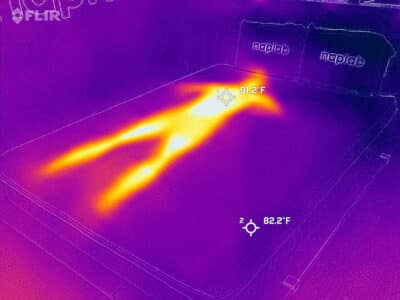
Max. Temp.
91.2° F
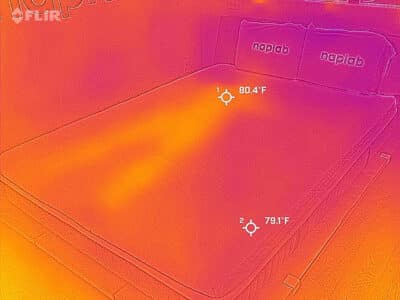
Ending Temp.
80.4° F
This level of “good, but not great” cooling performance is typical of an all-foam mattress like the Emma Body Adapt.
The all-foam design simply means the mattress struggles more with airflow and heat retention, especially compared to hybrid mattresses and others that utilize coil layers.
Max. Temp.
Ending Temp.
- Baseline Temperature – the temperature of the mattress before anyone lies on it
- Maximum Temperature (0 minute) – the temperature of the mattress after lying on it for 15 minutes
- Ending Temperature (5 minute) – the temperature of the mattress after being lied upon and having no one on it for 5 minutes
Notably, the mattress is equipped with a thin, non-quilted cover. That cover is helping with breathability and cooling, but it alone isn’t enough to counteract the layers of foam below.
Overall, this feels like a very basic, thin, all-foam mattress with no notable cooling features or design elements (beyond the thin cover) that would help meaningfully improve cooling. All that to say, cooling is fine, but not great.
In our objective temperature tests, we measured a max surface level temperature of 91.2° F. This is 1.0° warmer than the average of 90.2° F, based on all of our tests to date.
After getting off the mattress, the temperature declined by 5.1 degrees from minutes 0 to 1, which is 0.3 degrees cooler than the average 0 to 1 minute decline of 4.8 degrees.
Heat Dissipation Over Time
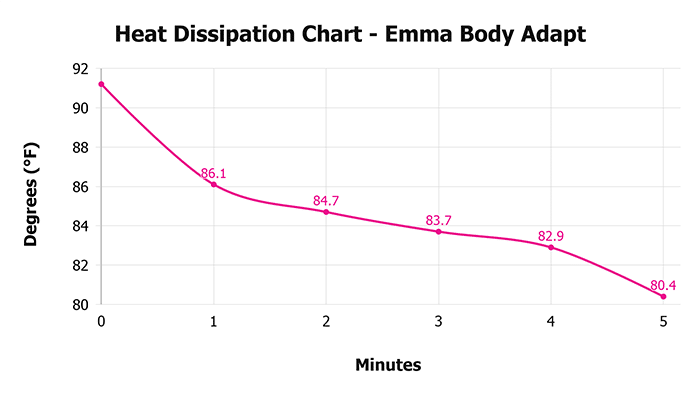
When we consider the combination of objective data, my subjective experiences, and an analysis of the materials, I’m confident in my view that cooling is good.
Sinkage Test
The Emma Body Adapt has moderate sinkage. During our tests, we measured a pressure point sinkage depth of 2.05″.
This is 0.20″ less sinkage than the average sinkage depth of 2.25″, based on all of our tests to date. The mattress creates a contouring hug that rides the line between slight and balanced, though I do think it leans more towards only a slight body hug.
Sinkage Depth
2.05″
Sinkage Feel
Moderate
Body Contour
Slight
The level of sinkage is documented in the image below.
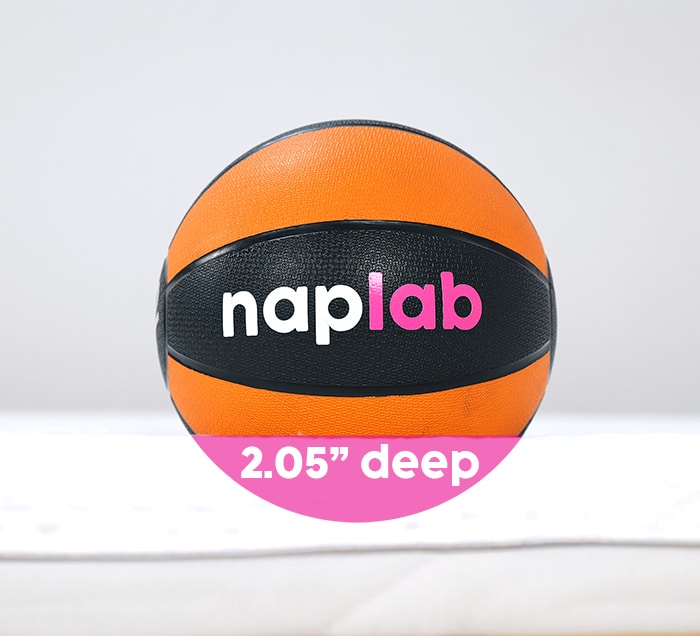
Likewise, it’s also on the borderline of creating more of a floating feel, where the body lies more “on” the mattress as opposed to sinking down “in” the mattress.
Fortunately, the Body Adapt is equipped with a memory foam layer that’s helping to support the more balanced sinkage dynamic and provide a measure of hug and pressure relief.
Even so, given the thinner-than-average comfort layer thickness and placement of memory foam below the poly foam in the layer stack, it’s a more restrained hugging feel.
Motion Transfer Test
The Emma Body Adapt has a high level of motion transfer. During our tests, we measured a total acceleration range of 12.16 m/s². This is 38% more motion transfer than the average of 8.78 m/s².
Accel. Range
12.16 m/s²
Motion Duration
0.70 seconds
This higher level of motion transfer seems to be resulting from the more limited sinkage level, thinner than average total mattress height, thinner than average comfort layer, thin taut cover (which tugs back and forth with movement), and usage of mostly poly foam (only 1.5” of memory foam).
Having less material in the mattress, but especially less comfort material, means that there is less material to absorb and disperse energy. As a result, more energy bounces off the foundation and back through the mattress to the sleeper.
The level of motion transfer is also documented in the video below.
In our motion transfer chart, which visualizes our accelerometer data, we can see the highest motion peaks from 0 to 0.2 seconds.
Motion declines thereafter, but we did also measure a secondary energy spike from 0.4 to 0.5 seconds. By 0.70 seconds, we’ve returned to near zero levels of energy, which is 0.20 seconds shorter than the average motion duration of 0.90 seconds.
If there is a silver lining, it’s that motion duration is notably better than average.
Motion Transfer Over Time
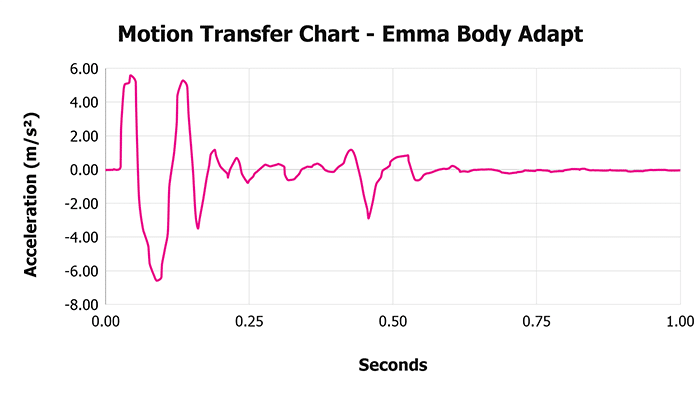
So while the motion intensity is higher than average, it doesn’t last long. Even so, this level of motion intensity is far from great, and I fear it will be bothersome to many sleepers.
Response Test
The Emma Body Adapt has a moderate material response.
In our mostly recovered test, we measured a recovery speed of 0.6 seconds, which is 0.18 seconds slower than the average of 0.42 seconds, based on all of our tests to date.
Mostly Recovered
0.6 sec.
Fully Recovered
1.2 sec.
In our fully recovered responsiveness test, we measured a recovery speed of 1.2 seconds, which is 0.18 seconds slower than the average of 1.02 seconds.
This mattress is a tale of two foams.
We have the poly foams in the mattress, which are all highly responsive and spring back to shape quickly. And then we have the memory foam layer, which has a more traditional feel and as such, is incredibly slow to recover back to its original shape after it has been compressed.
The level of responsiveness is documented in the video below.
While the bulk of the foams in the Body Adapt spring back to shape quickly, the single memory foam layer slows down the total material recovery speed of the mattress.
As a result, ease of movement is negatively impacted by the slower-than-average response. Fortunately, it’s only slightly worse than average, so I wouldn’t describe it as a deal breaker. Nevertheless, more sensitive sleepers could find it troublesome.
Bounce Test
The Emma Body Adapt has a low level of bounce. During our tests, we measured a total bounce height of 6.63″. This is 2.07″ less bounce than the average of 8.70″, based on all of our tests to date.
Max. Depth
4.44″
Max. Rebound
2.19″
Total Bounce
6.63″
All-foam mattresses typically have less bounce than average, and that’s exactly what we measured here. The all-foam construction simply creates less resiliency.
In addition, the 1.5” slower recovery memory foam layer is also suppressing bounce.
Max. Sinkage Depth
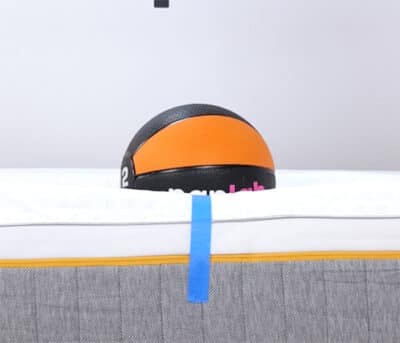
Max. Bounce Height

The level of bounce is also documented in the video below.
The lower bounce makes ease of movement and sex performance worse. However, it also helps to keep motion transfer in check. So there are pros and cons to consider.
Edge Support Test
The Emma Body Adapt has excellent sitting edge support and excellent lying edge support.
Max. Sinkage
3.50″
Lying Support
Excellent
Reinforced Edge
No
In our sitting edge support test, we measured a sitting sinkage compression of 3.50″. This is 0.34″ less sitting sinkage than the average of 3.84″, based on all of our tests to date.
The level of edge support while seated is documented in the images below.
Sitting, 140 lbs.

Sitting, 200 lbs.
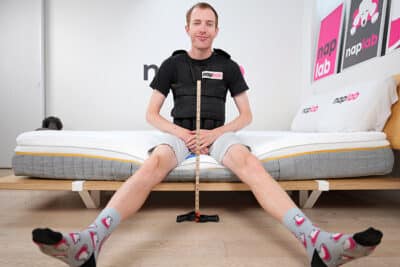
While lying directly on the edge of the mattress, I felt that the support was excellent in all sleeping positions.
While the thinner-than-average comfort layer isn’t doing any favors for comfort or pressure relief, it is beneficial for edge support. This mattress creates less sinkage in general and that more restrained sinkage extends to the edge.
Notably, this mattress does not use any type of reinforced edge support.
The level of edge support while lying is documented in the images below.
Lying on Edge, 140 lbs.

Lying on Edge, 200 lbs.

Nevertheless, it doesn’t need it. Edge support is strong for both sitting and lying. I expect most sleepers will find it sufficient.
Sex Test
The Emma Body Adapt has fair sex performance. First up, let’s talk through the positives. The mattress creates minimal noise, has good (but not great) pressure relief and cooling, and excellent edge support.
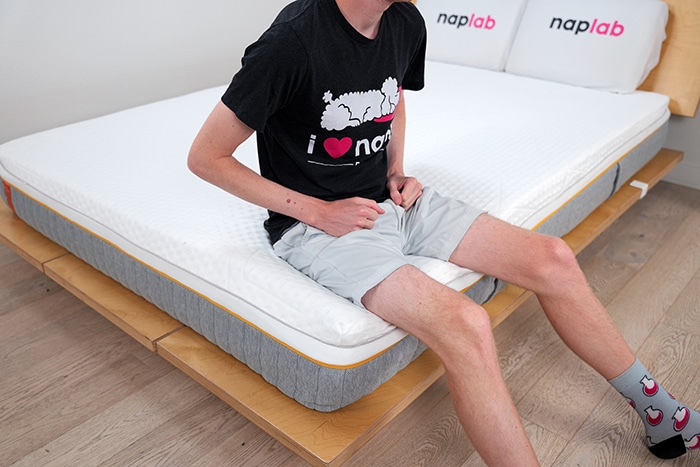
In our edge tests, we measure edge sitting sinkage compression at 3.50”. This is better than average and means we have a more robust and supportive edge, extending the usable surface area on the mattress.
While 4 of the 5 sex testing categories were solid, the Emma Body Adapt greatly struggled with bounce.
| Sex Factor | Factor Weight | Score | Rating |
|---|---|---|---|
| Bounce | 65% | 6.6 | Low |
| Edge Support | 20% | 9.4 | Excellent |
| Noise | 5% | 10 | Minimal |
| Pressure Relief | 5% | 8.0 | Good |
| Cooling | 5% | 8.0 | Good |
In our bounce test, we measured a total bounce height of 6.63”. This is considerably less bounce than average. A mattress with less bounce simply means the mattress can be more tiring and strenuous for amorous activities.
As a result of the below-average level of bounce, we also have a sex score that is notably worse than average.
Pressure Relief Test
The Emma Body Adapt has a good level of pressure relief. During our tests, I felt no significant pressure points on my body. That said, while pressure relief was good, it was also clear it’s far from great.
Comfort Layer
3.50″
Support Layer
6.00″
The mattress is equipped with 3.5″ of comfort material, which is 0.84″ less comfort material than the average comfort layer thickness of 4.34″, based on all of our tests to date.
In terms of quality, the foam layers feel fine, but it’s also fair to say they are far from amazing. The thin, non-quilted cover creates more direct engagement with the foams.
Nevertheless, this mattress creates less sinkage (on the border between moderate and minimal sinkage depth) and has more of a floating, buoyant feel.
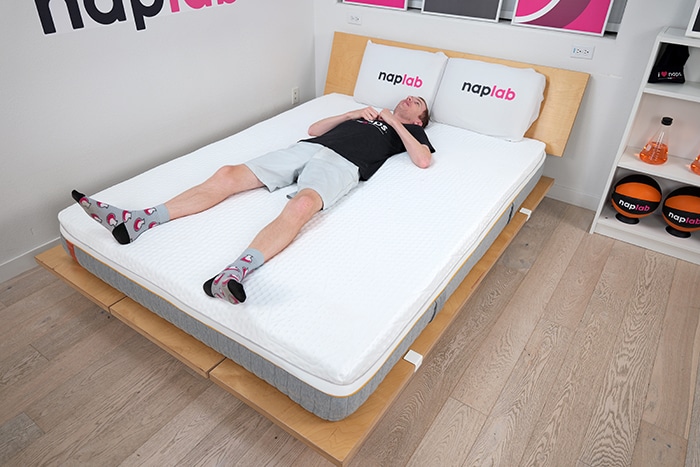
If your preferred comfort dynamic has a big dramatic body contouring hug, then this mattress is not going to work well for you. Emma’s Body Adapt has only a slight hug and more of a floating feel where you’ll like more “on” the mattress instead of sinking down “in” the mattress.
In our objective pressure mapping tests, we measured a max PSI of 0.33, which is well within the 1.0 PSI threshold I want to see.
Pressure Map – Side Sleepers

| Pressure Relief (PSI) | Average | Maximum |
|---|---|---|
| Side Sleepers | 0.09 | 0.33 |
Pressure Map – Back Sleepers

| Pressure Relief (PSI) | Average | Maximum |
|---|---|---|
| Back Sleepers | 0.07 | 0.33 |
Pressure Map – Stomach Sleepers

| Pressure Relief (PSI) | Average | Maximum |
|---|---|---|
| Stomach Sleepers | 0.06 | 0.27 |
When I consider our objective pressure mapping tests, material thickness, material quality, and my subjective experience on the mattress, I’m confident most sleepers will find the pressure relief to be good.
Off-Gassing Test
The Emma Body Adapt had a strong smell upon the initial unboxing. The mattress smelled for 30 days. This is 22.5 days longer than the average smell duration of 7.5 days.
Initial Smell Strength
Strong
Off-Gassing Period
30 days
Company
Emma mattresses come with a 365-night trial period and a 15-year warranty. Shipping and returns are both free.
| Company Factor | Factor Weight | Score | Data |
|---|---|---|---|
| Returns | 40% | 10 | $0 |
| Trial Period | 30% | 10 | 365 nights |
| Warranty | 20% | 8.0 | 15 years |
| Shipping | 10% | 10 | $0 |
| Country of Origin | 0% | Thailand |
Comparing 117+ brands tested to date, the average trial period is 191 nights, 174 nights less than Emma offers. The average warranty is 13 years, which is 2 years less than this mattress, and that’s if we exclude the 42% of mattresses that offer lifetime warranties.
How firm is Emma Body Adapt?
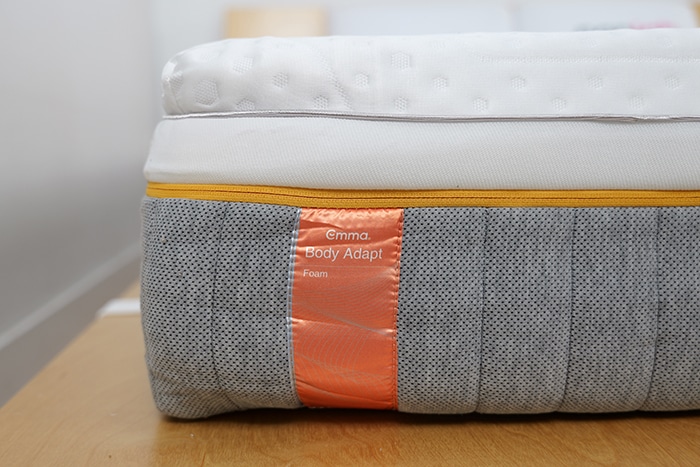
The Emma Body Adapt mattress is available in a single firmness option, which the brand states is a 3 out of 10, where 10 is the most firm. This is an incredibly soft rating, and, in our experience, it’s not accurate.
We rate the Emma Body Adapt to have a standard medium-firm feel with a 6 out of 10 rating.

To achieve a soft rating of 3 out of 10, it usually requires a thickness of 12 – 16″, which this mattress is far from.
Support & Sleeping Positions
Support on the Emma Body Adapt is good. During our tests, I felt reasonably well supported by the mattress.
| Support Factor | Data |
|---|---|
| Comfort Layer | 3.50″ |
| Support Layer | 6.00″ |
| Firmness | Medium-Firm |
| Body Contour | Slight |
| Zoned Support | Yes |
| Reinforced Edge | No |
The mattress is equipped with a 6.0″ support layer. This is 1.97″ thinner than the average support layer thickness of 7.97″, based on all of our tests to date.
Mattresses with the best support are able to meet 2 critical criteria. First, they support the body, maintaining a neutral spinal alignment. Second, they create sufficient comfort.
While the Body Adapt meets these requirements, it’s also fair to say the support and comfort performances are far from great. In terms of pressure relief, the thinner-than-average comfort layer and more limited foam quality aren’t ideal.
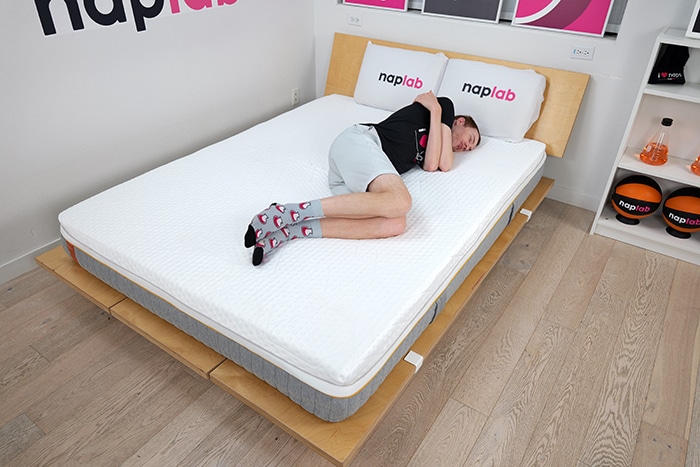
In terms of support, we have a more restrained hug and less sinkage. Some sleepers will prefer that sinkage dynamic, but I do think it’s one that isn’t ideal for all sleepers.
Check out the table below to see the sleeper weights and sleeping positions that would be best suited for this mattress.
| Sleeper Weight | Stomach Sleeper | Side Sleeper | Back Sleeper |
|---|---|---|---|
| Under 150 lbs. | Yes | Yes | Yes |
| 150-250 lbs. | Yes | Yes | Yes |
| 250-300 lbs. | Yes | Yes | Yes |
If you prefer a more balanced feel with more sinkage and hug, the Emma Body Adapt isn’t a good choice for you.
Moving on, let’s talk about firmness. In our tests, we rated the firmness at a 6 out of 10, medium-firm feel. This firmness is appropriate to most sleepers. That said, I’m alarmed by Emma’s self-rated firmness assessment, which rates the mattress at a 3 out of 10.
In my view, this mattress is nowhere near a 3 firmness, which would give it a soft and plush feel. There is simply nothing about this mattress that is soft or plush.
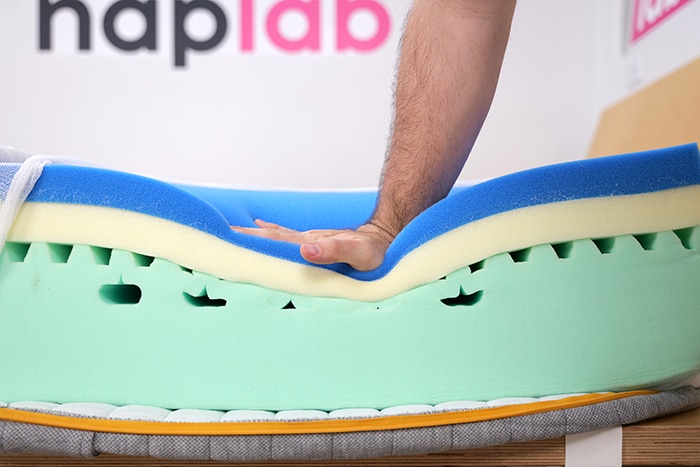
Lastly, this mattress does use zoned support, which helps to create different levels of support for different parts of the body. That said, the type of zoned support it’s using is cut channels into the support foam, as opposed to dedicated support layers or a zoned coil unit.
While I do like to see zoned support, this particular type of zoned support doesn’t appear to have a significant impact on performance.
Based on all of my tests to date, an analysis of the materials, and my subjective experiences, I’m confident most sleepers will find support on the Emma Body Adapt is good.
Design
The Emma Body Adapt is a 9.50″ foam mattress that comes in a single firmness option—Medium-Firm. It has an all-foam design that is simple and thinner than the average mattress.
Emma states that the mattress is 10″ thick, but the one we tested was a bit shy of that threshold, measuring at 9.5″ thick.
| Design Factor | Data |
|---|---|
| Type | Foam |
| Thickness | 9.50″ |
| Cover Type | Thin |
| Weight | 88 lbs. |
| Has Handles | Yes |
| Fiberglass-Free | Yes |
| Ships in a Box | Yes |
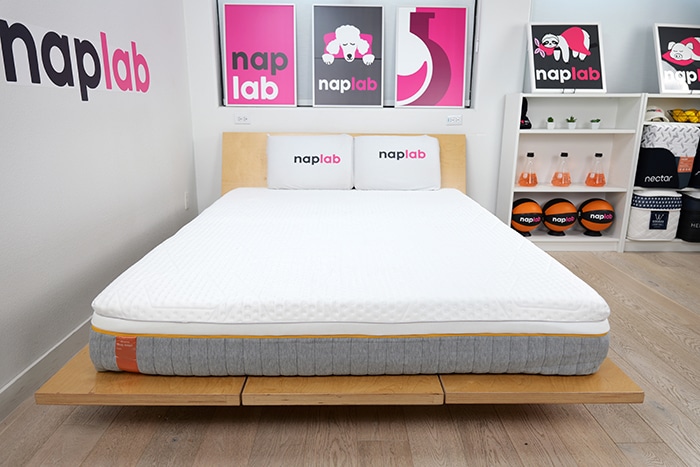
Materials
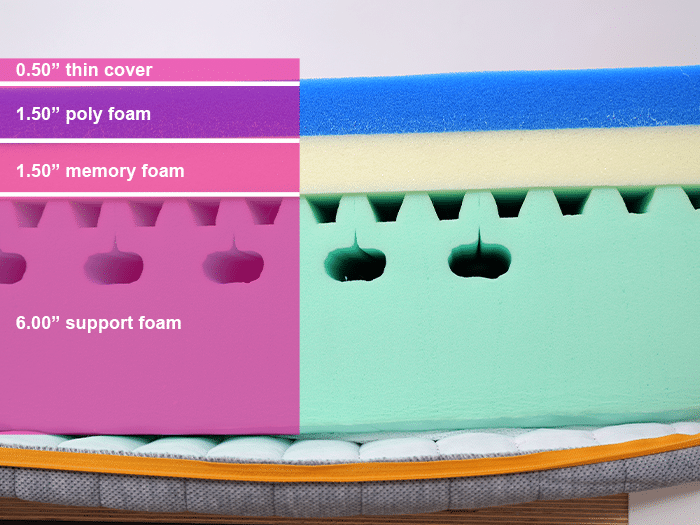
The Emma Body Adapt is 9.50″ thick and contains a combination of different foam types. From top to bottom, here is a full list of the materials used in this mattress:
| Layer Type | Thickness | Manufacturer’s Specs | Tested Specs |
|---|---|---|---|
| Poly Foam | 1.50″ | Not Available | 2.05 PCF |
| Memory Foam | 1.50″ | Not Available | 3.04 PCF |
| Support Foam | 6.00″ | Not Available | 1.85 PCF |
The Law Tag outlines the full breakdown of materials included in this mattress.
- Materials
- Top Cover
- 100% POLYESTER + PURO TEX TREATMENT
- Border Fabric:
- 100% POLYESTER
- Bottom Cover:
- 85% Polyester
- 15% Polypropylene
- Top Cover
- Imported to Canada by: Emma Sleep Canada Inc. 1055 West Georgia Street, 1500 Royal Centre, P.O. Box 11117, Vancouver BC, V6E 4N7, Canada
- Made In Thailand
The Cover
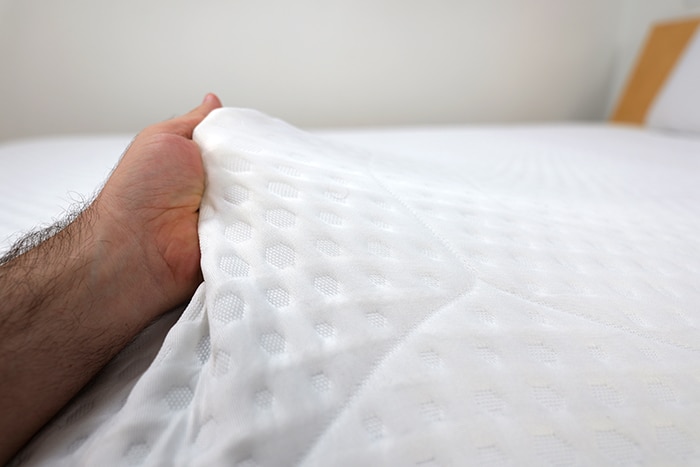
The Emma Body Adapt has a 0.5″ thin cover. It is thin, breathable, and has a bit of stretch to it. This cover is removable and machine washable. Emma also states that the fabric is antimicrobial.
The Comfort Layer
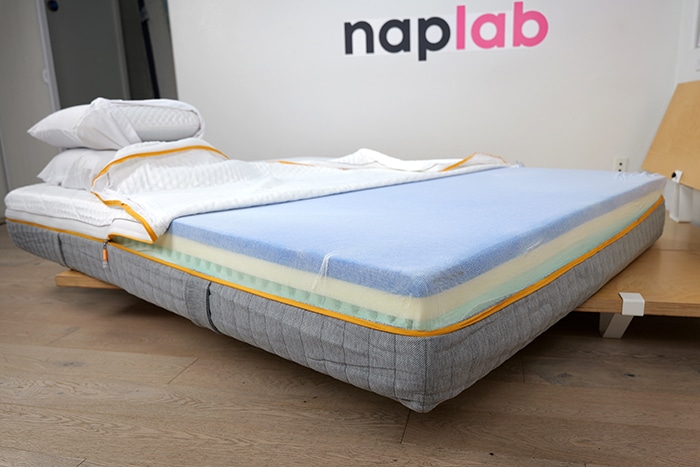
The comfort layer is 3.50″ thick, including the top cover. Below the cover is a 1.5″ poly foam (blue foam) followed by a 1.5″ memory foam (pale yellow foam).
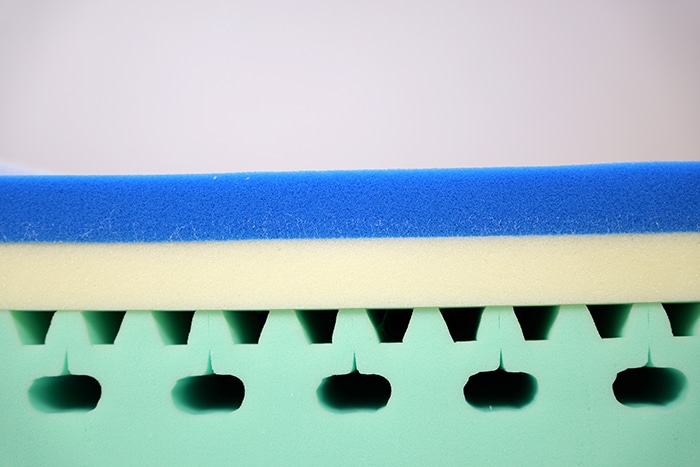
By combining different types of foam, the Emma Body Adapt has a balanced feel above the support layer.
The Support Layer
The support layer is 6.00″ thick and made of a single 6.0″ layer of foam (green foam). This layer is channel-cut at the top, which does help with response time and pressure relief.
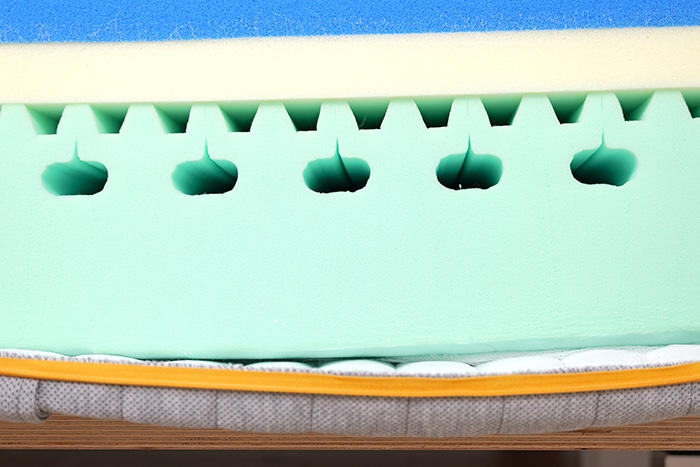
That said, it is still only 6.0″ thick, which is considerably thinner than the average support layer.
Product Evolution
The Emma Body Adapt is a new version of an old mattress. The Body Adapt was released in 2026 to replace the Emma Original all-foam mattress.
Earlier versions of Emma Original mattress can be traced back 2015, when the brand first launched in Europe.
It was later renamed the Comfort Adapt All-Foam in 2018 when launched in the US market. In 2022, the name circled back to the Emma Original, before being renamed again in 2026 to the Emma Body Adapt.
The origins of this mattress have always been an all-foam mattress, except for a brief period in 2025 when the Emma Original was redesigned to be a hybrid.
Other Mattresses to Consider
Not sure if the Emma Body Adapt is the right pick for you? Check out these three other top-rated foam mattresses for alternatives you may want to consider.
For Performance
Douglas Summit
Top-Rated Foam Mattress
The Douglas Summit is a 12″ foam mattress available in 1 firmness level—medium-firm. This mattress has a similar price tag, but significantly better overall performance than the Emma. It has minimal sinkage and low levels of bounce, giving the mattress a balanced feel.
For Deeper Sinkage
Endy
Deeper Engagement, Active Feel
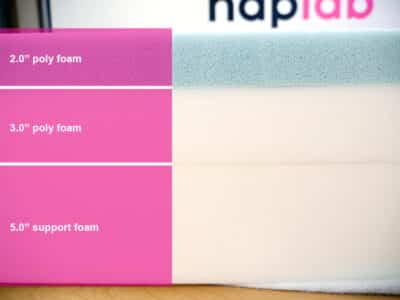
The Endy is a 10″ foam mattress available in 3 firmness levels—medium, slightly firm, and firm. For something slightly softer than Emma, I would recommend the Endy Plush, which has a medium feel (5 out of 10) and deeper sinkage. This mattress has significantly more bounce than the Emma.
For Less Sinkage
Octave Mirage
13″ Foam Mattress
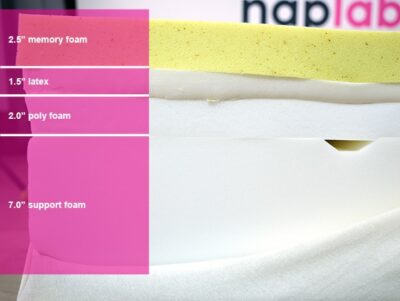
The Octave Mirage is a 13″ foam mattress available in 1 firmness level—medium-firm. The Mirage is a bit thicker than the Emma and has less sinkage. If you prefer to sleep “on the mattress”, this could be a great option for you to consider.
Frequently Asked Questions
Still have questions? Check out some of the top FAQs on the Emma Body Adapt mattress below and get the answers you’re looking for.
How much does an Emma Body Adapt mattress cost?
Here are the current prices of the Emma Body Adapt mattress, with any sales or promotions reflected below:
Twin: C$533
Full: C$629
Queen: C$719
King: C$869
*Note: Sales prices are subject to change without notice or warning.