Red-eye flights can feel like a smart travel hack. You board late, land early, and ideally sleep through the hours you would have spent awake in the air. For some travelers, that means saving money, maximizing vacation time, and avoiding a full day lost to travel.
But the tradeoff is right there in the name. Red-eye flights often come at the expense of sleep, comfort, and the ability to function the next day. Even if the fare is cheaper, arriving exhausted can make that “deal” feel a lot less worthwhile.
To better understand how Americans feel about overnight flights, NapLab analyzed traveler preferences, red-eye habits, and flight pricing trends to see when red-eyes are actually worth it. From how many people avoid them entirely to which airlines offer the biggest savings, our study looks at the real cost of flying overnight.
Key Findings
- Red-eye flights are 8% cheaper than daytime flights on average, but the savings depend heavily on when travelers fly.
- Weekend red-eyes offer the biggest savings, costing 22% less than weekend daytime flights on average.
- Weekday red-eyes are actually more expensive, costing nearly 10% more than weekday daytime flights on average.
- 91% of American frequent flyers have taken a red-eye flight, but only 20% say they prefer them.
- More than 1 in 3 travelers rarely or never sleep on planes, and America’s most common plane sleep quality rating is just 2/10.
Methodology
To determine if red-eye flights are worth losing sleep, we analyzed hundreds of flight options listed on Google Flights for both red-eye and daytime flights across 10 popular domestic routes that offer red-eye flights. Flight routes analyzed: LAX to JFK, LAX to BOS, LAX to MIA, LAX to ORD, SFO to JFK, SFO to BOS, SFO to EWR, SEA to JFK, SEA to BOS, and SAN to JFK.
In this study, a daytime flight is defined as a flight that departs and arrives on the same day, whereas a red-eye flight departs at night and lands sometime the next day, usually early in the morning.
To eliminate the influence of differing layovers on flight prices and to account for the fact that most domestic red-eye flights are offered on west-to-eastbound routes due to time zones, only nonstop, one-way flights were considered.
For each route and each airline, the cheapest flight price was recorded for daytime and red-eye flights on both a non-holiday weekday and a non-holiday weekend in September. All flight prices were collected about three months before the departure dates, during the week of June 8th – June 12th, 2026. Prices were collected on three different days over the course of the week, and the average of the three prices was used in the analysis to help eliminate short-term price fluctuations from influencing the analysis. Prices were collected by airline, with airlines only being included if they offered both a nonstop one-way daytime flight and a red-eye flight for the route. The five airlines included in this study are Alaska Airlines, American Airlines, Delta Airlines, JetBlue, and United Airlines.
Additionally, we surveyed over 1,000 Americans with a travel hobby from across the United States. Responses were collected in June 2026.
Red-Eye Flights Are Cheaper Overall, But Not Always
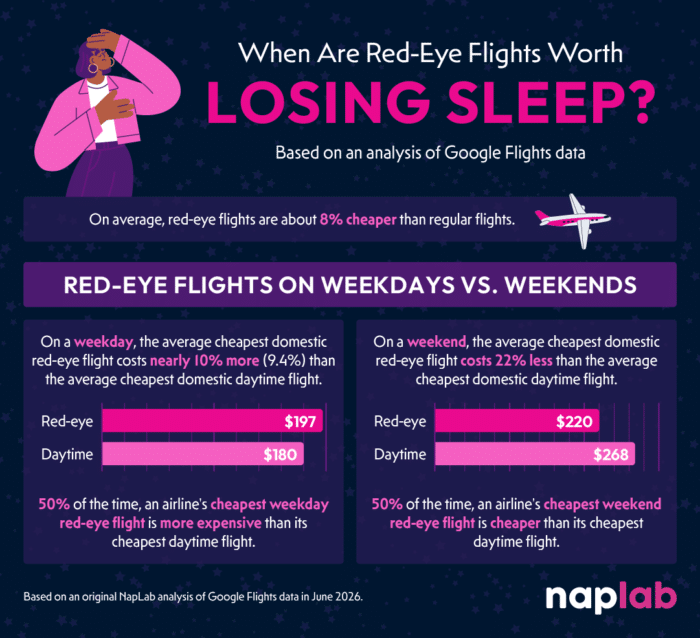
Red-eye flights have a reputation for being the cheaper option, with 93% of frequent flyers believing they’re generally cheaper than daytime flights, and overall, that checks out. Across the domestic routes we analyzed, red-eye flights were about 8% cheaper than comparable daytime flights on average.
However, that discount depends heavily on when you fly.
For weekday travel, red-eyes were actually more expensive. The average cheapest domestic red-eye flight on a weekday costs $197, compared to $180 for the average cheapest daytime flight. That means weekday red-eyes cost nearly 10% more on average.
Weekends told a very different story. The average cheapest domestic red-eye flight on a weekend costs $220, while the average cheapest daytime flight costs $268. That makes weekend red-eyes 22% cheaper on average.
In other words, red-eyes can be worth it if you are trying to save money, but they are not automatically the budget option. For weekday flights, travelers may be paying more to arrive tired. For weekend flights, the savings are much stronger and may be enough to make the lost sleep feel like a fair trade.
Why Do Americans Book or Avoid Red-Eye Flights?
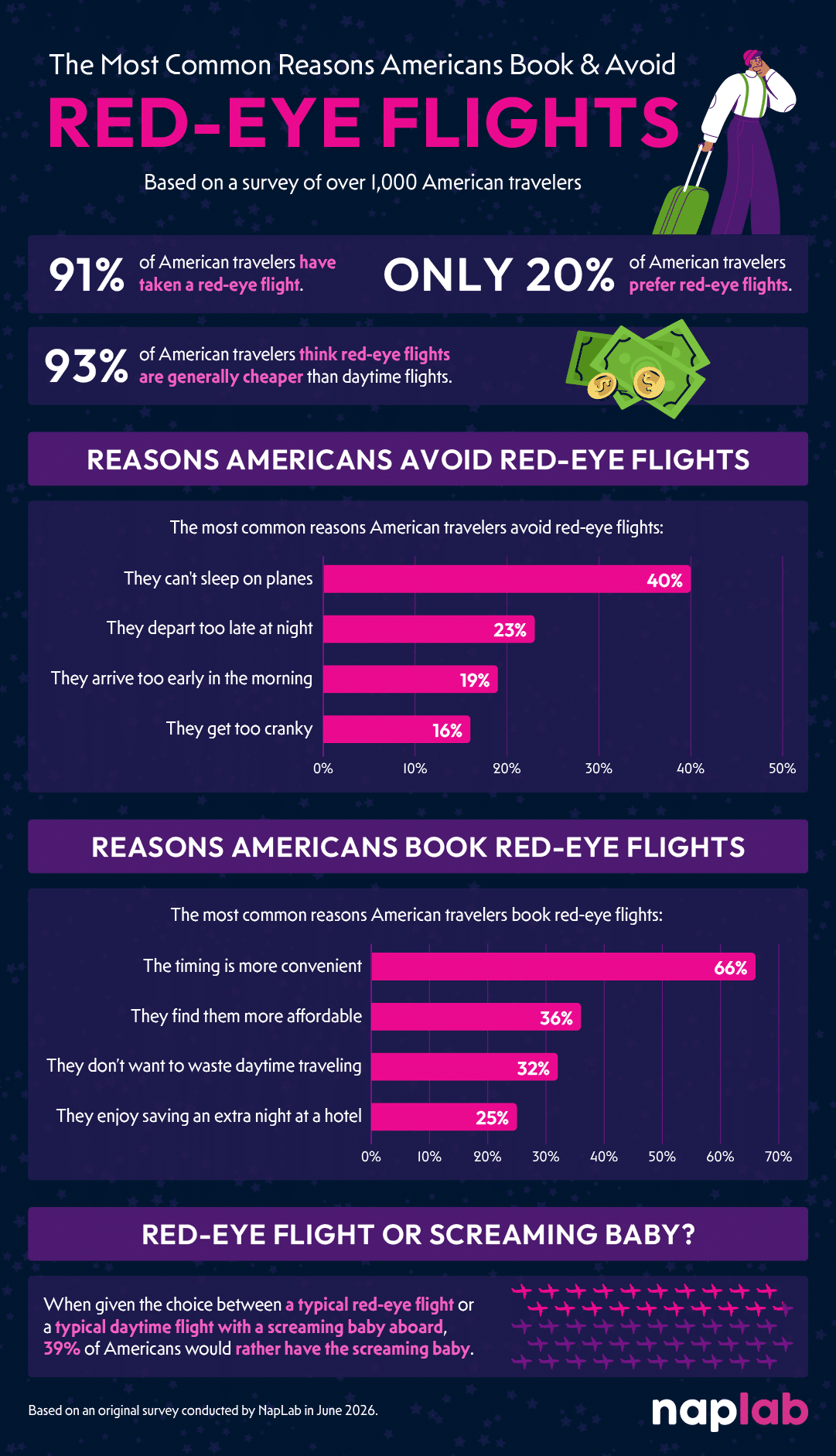
According to our survey of over 1,000 American travelers, 91% have taken a red-eye flight before. However, only 20% say they actually prefer red-eye flights over other flight times.
Part of the appeal is the assumption that red-eyes are cheaper. In fact, 93% of American travelers think red-eye flights are generally cheaper than daytime flights. As our flight price analysis found, that is true overall, but not always. Red-eyes were cheaper on average, but weekday red-eyes were actually more expensive than daytime flights.
The biggest reason Americans avoid red-eye flights is simple: They cannot sleep on planes. About 40% of travelers say this is why they avoid them. Another 23% say red-eyes depart too late at night, 19% say they arrive too early in the morning, and 16% say red-eyes make them too cranky.
For those who do book red-eyes, convenience is the biggest motivator. Two-thirds of travelers (66%) say they book red-eye flights because the timing is sometimes more convenient. Another 36% book them because they find them more affordable, while 32% would rather sleep while they travel instead of wasting daytime hours in the air.
Other travelers see red-eyes as a way to stretch their trip. About 25% say they like not having to pay for an extra night at a hotel, while 18% say they sleep fine on planes, and 15% say they are night owls.
Still, the tradeoff is not an easy sell for everyone. When given the choice between a typical red-eye flight or a typical daytime flight with a screaming baby aboard, 39% of Americans said they would rather take the daytime flight with the screaming baby. That says a lot about how many travelers view overnight flights!
How Do Americans Sleep on Planes?
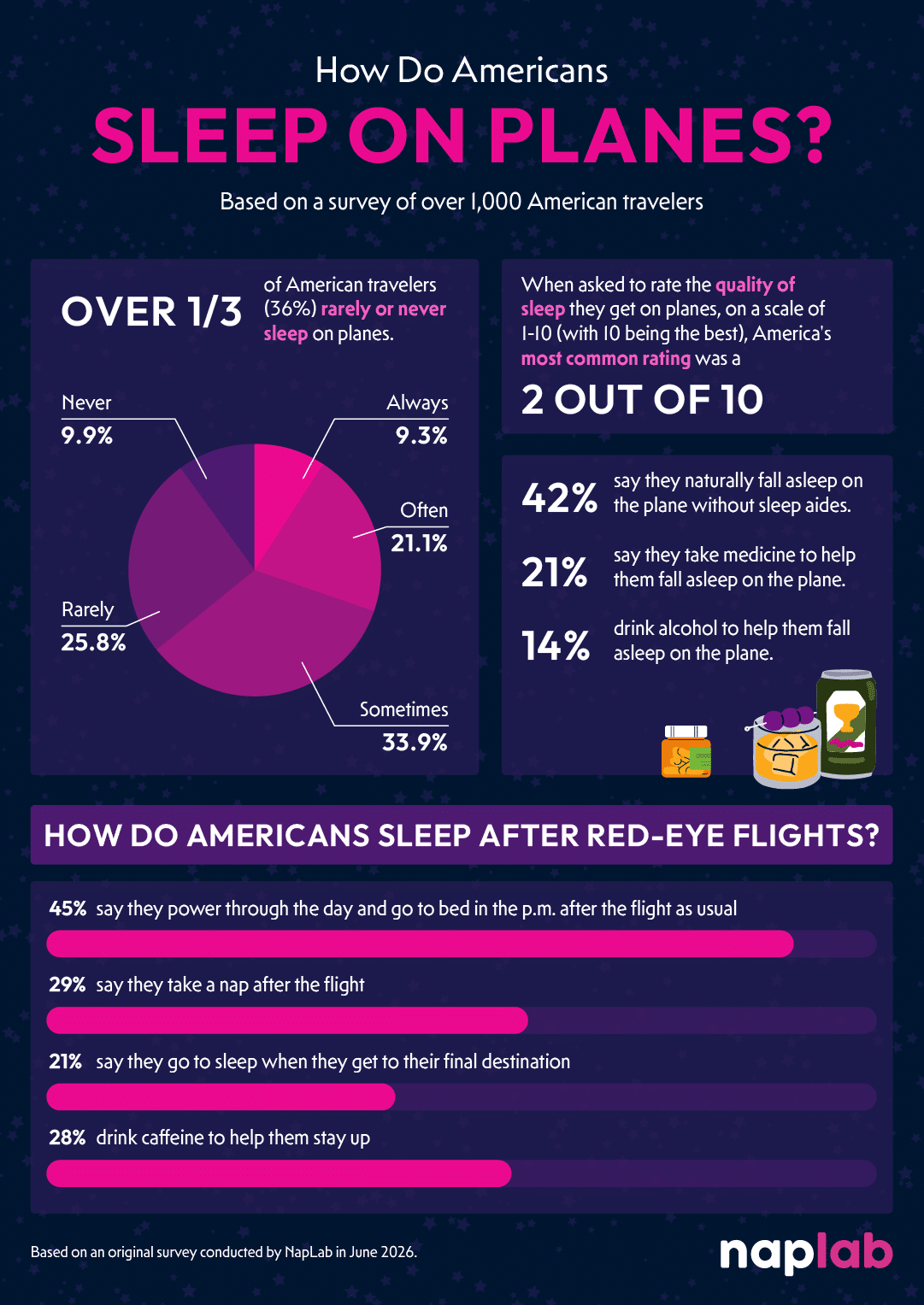
For many travelers, the hardest part of taking a red-eye is not the late departure or early arrival. It is the actual sleeping. More than 1 in 3 American travelers (36%) say they rarely or never sleep on planes, including 10% who say they never sleep on planes at all. On the other hand, only 30% say they always or often sleep while flying.
Even among those who do manage to fall asleep, the quality is not exactly great. When asked to rate the sleep they get on planes on a scale of 1 to 10, America’s most common rating was just 2/10. Still, travelers have their own ways of trying to make it work. About 42% say they naturally fall asleep on the plane without sleep aids. Another 21% take medicine to help them fall asleep, while 14% drink alcohol to help them sleep during the flight.
Once the plane lands, most travelers are left figuring out how to get through the day. After taking a red-eye, 45% say they power through and go to bed at their usual time that night. Another 29% take a nap after the flight, while 21% go to sleep once they reach their final destination. For 28%, caffeine is part of the recovery plan.
It’s important to remember that a cheaper fare may look good at checkout, but if the flight leaves you running on two hours of low-quality sleep and a large coffee, the savings may not feel quite as strong by the time you land.
How Do Americans Feel After Taking a Red-Eye Flight?
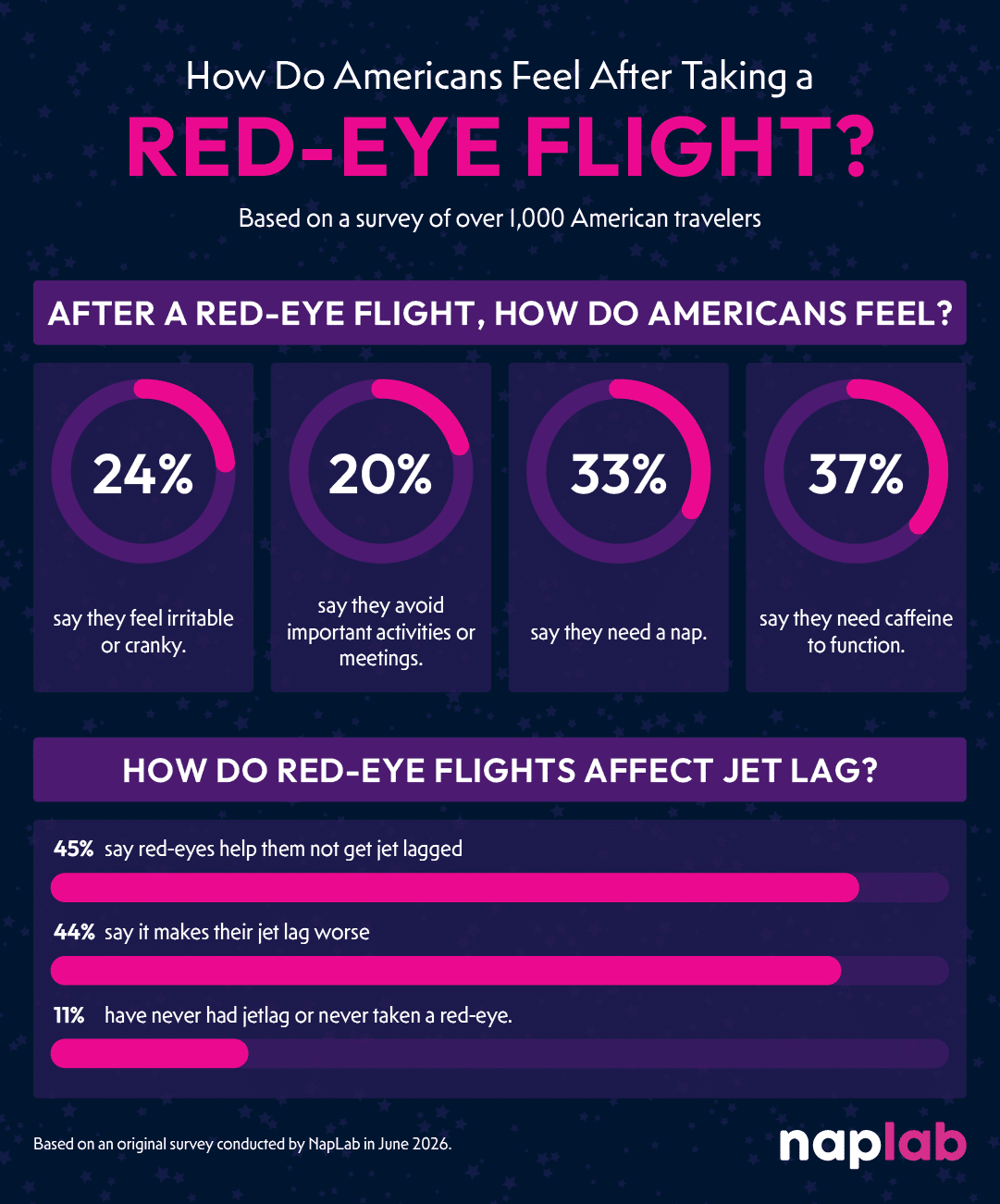
The true cost of a red-eye often shows up after landing. After taking a red-eye flight, 37% of American travelers say they need caffeine to function, while 33% say they need a nap. Another 24% say they feel irritable or cranky, and 20% avoid important activities or meetings after the flight.
That makes red-eyes a risky choice for travelers who need to be sharp the next day. Saving money on the flight may not feel worth it if the first day of the trip is spent fighting through exhaustion.
Jet lag is also a split decision. About 45% of travelers say red-eye flights help them avoid jet lag, while 44% say they make jet lag worse. Another 11% say they have never had jet lag or have never taken a red-eye.
In other words, red-eye flights can either help travelers adjust or make the problem worse. It depends on the flight, the time zone, and how well you can sleep in an airplane seat.
Which Airlines Charge the Most and Least for Their Cheapest Domestic Red-Eye Flights, on Average?
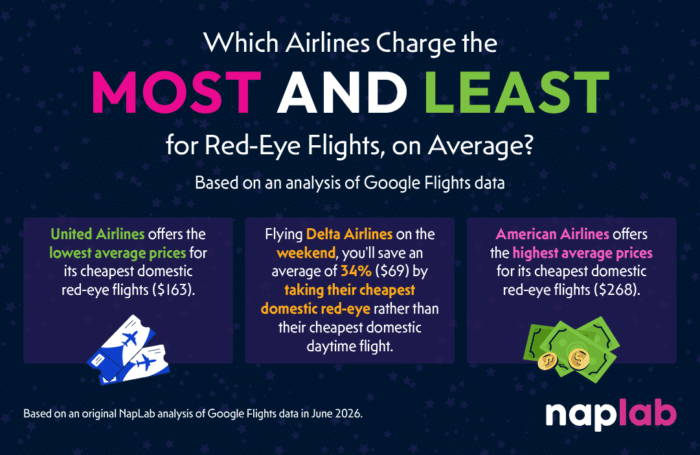
Red-eye flight prices also vary by airline, and some carriers are much better bets than others. Across the domestic routes we analyzed, United Airlines offered the lowest average prices for its cheapest domestic red-eye flights ($163). For travelers who are mostly focused on keeping costs down, United was the strongest option overall.
Delta Airlines also stood out on weekend flights. On average, travelers flying Delta on the weekend can save 34% ($69) by choosing the cheapest domestic red-eye flight instead of the cheapest daytime flight.
American Airlines landed on the other end of the list, offering the highest average prices for its cheapest domestic red-eye flights ($268). That does not mean American’s red-eyes are never worth booking, but among the airlines in our analysis, they were the least likely to offer the lowest-priced red-eye option.
The bottom line: If you are booking a domestic red-eye to save money, it is worth comparing airlines closely. Red-eyes may be cheaper overall, but the best deal depends on both the carrier and the day you fly.
Closing Thoughts
Red-eye flights can be worth it, but they are not the automatic travel bargain many people assume they are. Our analysis found that red-eyes are about 8% cheaper overall, but timing matters. On weekdays, the average cheapest red-eye flight actually costs more than the average cheapest daytime flight. On weekends, the savings are much stronger, with red-eyes costing 22% less on average.
The bigger question is whether the savings are worth the sleep tradeoff. Many travelers struggle to sleep on planes, and even those who can sleep often report poor sleep quality. For some, a red-eye is a smart way to save money, skip an extra hotel night, and make the most of their travel time. For others, it is a fast track to caffeine, crankiness, and a lost first day of the trip.
At NapLab, we know good sleep is not always easy to get, especially when you are 30,000 feet in the air. But once you are back home, your mattress should help you recover without any extra hassle. Take our personalized mattress quiz to find the best mattress for your body, sleep position, and budget.
Fair Use
You are welcome to use, reference, and share non-commercial excerpts of this study with proper attribution. If you cite or cover our findings, please link back to this page so readers can view the full methodology, charts, and context.