Best For
- Fast material response time
- Great sex + relatively low motion transfer is a good combination for couples
- Extremely low price, under $200 for a queen mattress
Considerations
- Performs well below average overall—bottom 6% of all mattresses tested to date
- Poor cooling with significant levels of heat retention
- Struggles with pressure relief
Our Verdict
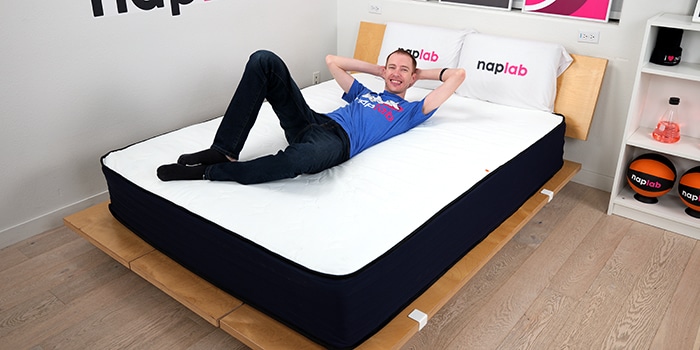
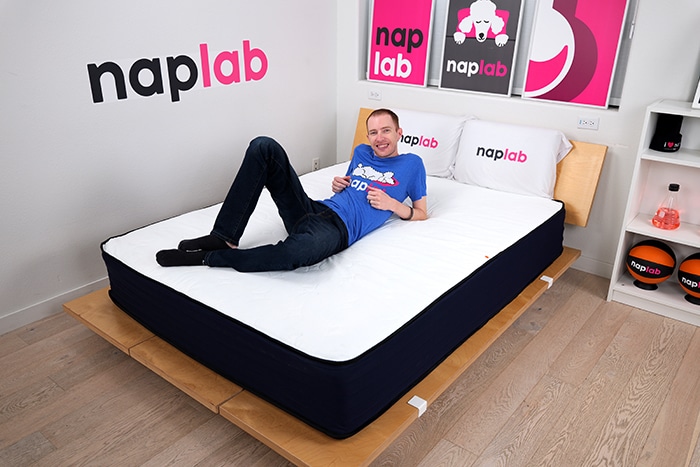
The NapQueen Victoria is a 12.00″ hybrid mattress made of a poly foam comfort layer and a pocketed coil support layer. It is sold on Amazon, offering an attractive option if you need a low-budget mattress with 2-day Prime delivery, but it comes with some big performance disadvantages.
The NapQueen Victoria is available in a single firmness level — medium-firm. This is a 6 out of 10 on our firmness scale, where 10 is the most firm.
This mattress has deep sinkage and high levels of bounce. This deeper engagement is paired with only a slight degree of body contour. For sleepers who are looking for deep sinkage without feeling stuck or overly enveloped, the Victoria could possibly be an option. But it’s not without its fair share of disadvantages.
In our performance tests, this mattress earned an overall score of 7.37, ranking the mattress in the bottom 6% of all mattresses tested to date. Poor cooling, poor pressure relief, and strong off-gassing were among its three weakest areas.
The NapQueen Victoria is only $195 for a queen-sized mattress, which is 87% less expensive than average. If you’re on a tight budget or need a temporary solution, the Victoria may fit the bill. That said, for most sleepers I would recommend going with a higher performance, higher quality mattress.
Type: Hybrid
Firmness: Medium-Firm (6)
Best For: None
In This Review
Performance Tests | Firmness | Support & Sleeping Positions | Design | Materials | Comparisons | FAQs
Performance Tests
At NapLab, we put each mattress to the test.
We test 10 different factors that impact the performance, comfort, and feel of the mattress. We then take the results of those tests and compare them to every mattress we’ve tested to date.
Check out the full performance table below to see how this mattress ranks:
| Factor | NapQueen Victoria | Average |
|---|---|---|
| Overall Score | 7.37 | 8.50 |
| Price (Queen) | $195 | $1,495 (Hybrid only) |
| Cooling – Score | 5.0 | 8.6 |
| Sinkage – Depth | 2.49″ | 2.25″ |
| Sinkage – Feel | Deep | Moderate |
| Motion Transfer – Score | 8.2 | 8.2 |
| Motion Transfer – Acceleration | 9.03 m/s² | 8.85 m/s² |
| Response Time – Score | 9.6 | 8.8 |
| Response Time – Mostly Recovered | 0.2 sec. | 0.4 sec. |
| Response Time – Fully Recovered | 0.7 sec. | 1.0 sec. |
| Bounce – Height | 10.99″ | 8.69″ |
| Bounce – Feel | High | Moderate |
| Edge Support – Score | 8.7 | 8.7 |
| Edge Support – Sitting | 3.50″ | 3.89″ |
| Edge Support – Lying | Good | Good |
| Sex – Score | 9.0 | 8.2 |
| Pressure Relief – Score | 6.0 | 8.6 |
| Comfort Layer Thickness | 2.00″ | 4.31″ |
| Mattress Thickness | 12.00″ | 12.23″ |
| Off-Gassing – Score | 6.1 | 8.0 |
| Off-Gassing – Smell | Strong | Strong |
| Off-Gassing – Days | 14 days | 7 days |
| Company – Score | 9.0 | 8.8 |
| Trial | 100 nights | 188 nights |
| Warranty | 10 years | 40% have lifetime warranties, average of other 60% of mattresses is 13 years |
How is NapQueen Victoria Different?
The NapQueen Victoria is a 12.00″ hybrid mattress with an overall performance level that is below average, but also a price tag that is significantly below average as well. Compared to the average hybrid, the Victoria is $1,300 less—an 87% savings.
Advantages
Aside from the ultra-low price, other advantages to the Victoria include faster material response time, and better sex score. Higher bounce is the biggest driver for the high sex score, as bounce improves intimacy for most couples.
Neutral Factors
This mattress has deep sinkage and high bounce, which are both considered neutral factors since different sleepers may have different preferences in these areas.
Motion transfer and edge support are also neutral factors, in my opinion, because they scored right at the average level.
Disadvantages
The biggest disadvantages of the NapQueen Victoria include a very low cooling score, poor pressure relief, and strong off-gassing.
The cooling test revealed high levels of heat retention and a warm feel that was generally uncomfortable.
Pressure relief also struggled, largely due to the 2.0″ comfort layer. The average mattress has a 4.31″ comfort layer, which allows for pressure relief as your body can engage with deeper layers of comfort material.
But on the NapQueen, once you sink past the 2.0″ of comfort foam, it’s straight to the support layer below. This transition can cause more pressure points and a generally uncomfortable feel.
Lastly, off-gassing was strong, and the mattress took 14 days to fully off-gas, a full 2X longer than the average off-gassing time of 7 days.
Cooling Test
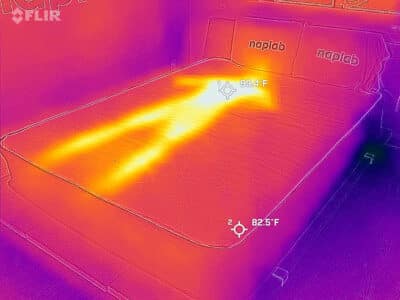
The NapQueen Victoria has poor cooling. During our tests, I felt significant heat retention on my body.
Baseline Temp.
76.8° F
Max. Temp.
93.4° F
Ending Temp.
81.9° F
The temperature was so notable that I would describe it as having a “warm” feel more broadly and a “hot” feel in some locations. Typically, hybrid mattresses have good cooling performance.
However, that’s not what we measured here. While the coil unit is bringing more airflow into the mattress, the foam comfort layers are retaining more heat and appear not to breathe particularly well.
Max. Temp.
Ending Temp.
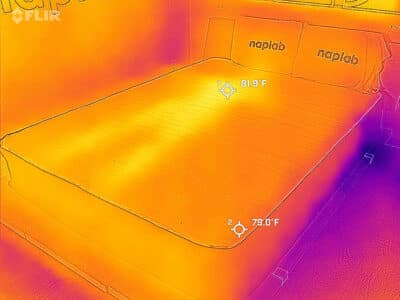
- Baseline Temperature – the temperature of the mattress before anyone lies on it
- Maximum Temperature (0 minute) – the temperature of the mattress after lying on it for 15 minutes
- Ending Temperature (5 minute) – the temperature of the mattress after being lied upon and having no one on it for 5 minutes
In my view, the primary issue is simply the foam quality. Lower spec foams often struggle with breathability and heat retention, and these foams look and feel low quality, in my view.
In our objective temperature tests, we measured a max surface level temperature of 93.4° F. This is 3.3° warmer than the average of 90.1° F, based on all of our tests to date.
After getting off the mattress, the temperature declined by 6.0 degrees from minutes 0 to 1, which is 1.2 degrees cooler than the average 0 to 1 minute decline of 4.8 degrees.
Heat Dissipation Over Time
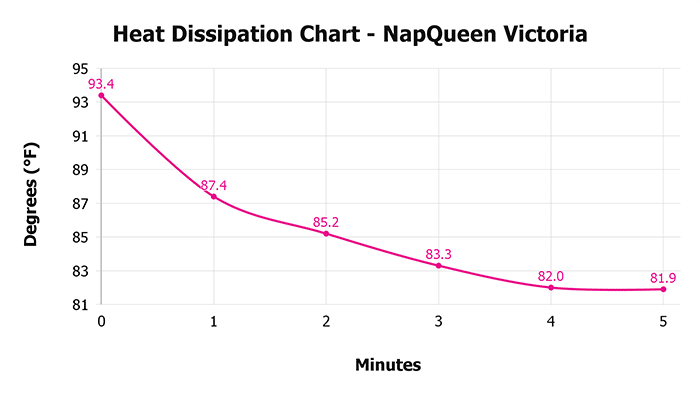
When we consider the combination of objective data, my subjective experiences, and an analysis of the materials, I’m confident in my view that cooling is poor.
Sinkage Test
The NapQueen Victoria has deep sinkage. During our tests, we measured a pressure point sinkage depth of 2.49″. This is 0.24″ more sinkage than the average sinkage depth of 2.25″, based on all of our tests to date.
Sinkage Depth
2.49″
Sinkage Feel
Deep
Body Contour
Slight
The level of sinkage is documented in the image below.
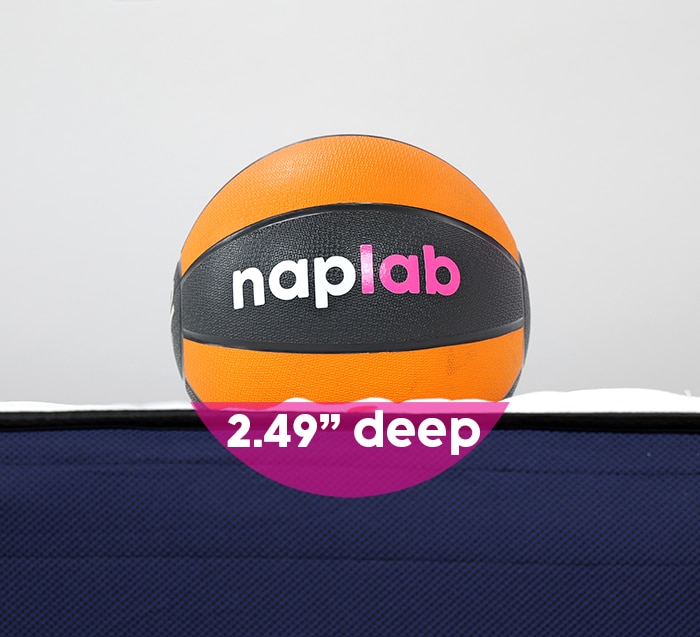
The mattress creates only a slight level of body contouring hug, despite the deeper sinkage. In my view, the unexpected aberration is a result of the thin 2.0” comfort layer and lower quality foams. 2.0” is just not enough comfort material to create much body contouring or hug.
Notably, the NapQueen Victoria product page states that the mattress uses “cooling gel memory foam”. However, in my view, it feels more like a typical, cheap poly foam.
This mattress does not create any type of memory foam feel. Instead, the foams are highly responsive and create very little body hug.
Motion Transfer Test
The NapQueen Victoria has a low level of motion transfer. During our tests, we measured a total acceleration range of 9.03 m/s².
Accel. Range
9.03 m/s²
Motion Duration
1.30 seconds
This is 2% more motion transfer than the average of 8.85 m/s². The slightly higher than average motion is resulting from the higher than average level of bounce.
When we have more bounce, we create more energy, and that extra energy can be experienced as motion transfer on the mattress. Certainly, the limited 2.0” comfort layer and coil unit are the greatest contributors to the extra bounce, energy, and motion.
The level of motion transfer is also documented in the video below.
In our motion transfer chart, which visualizes our accelerometer data, we can see the highest motion peaks from 0 to 0.2 seconds. Motion declines thereafter, but we do have a notable secondary energy spike from 0.6 to 0.8 seconds.
Motion Transfer Over Time
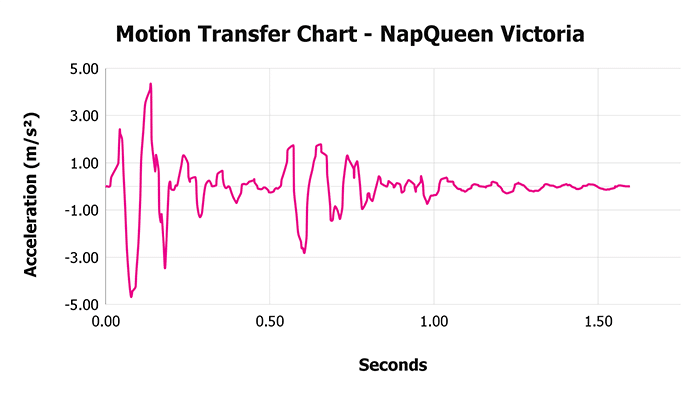
By 1.30 seconds, we’ve returned to near-zero levels of energy, which is 0.41 seconds longer than the average motion duration of 0.89 seconds. Certainly, we would have liked to have seen a shorter motion duration.
While the motion intensity is kept at a reasonable level, motion duration is considerably worse than average and shows how energy lingers longer through the thin comfort layer and coil unit.
Response Test
The NapQueen Victoria is a mixed bag for material responsiveness, with an extremely fast mostly recovered response time and a fast fully recovered response time.
Mostly Recovered
0.2 sec.
Fully Recovered
0.7 sec.
In our mostly recovered test, we measured a recovery speed of 0.2 seconds, which is 0.21 seconds faster than the average of 0.41 seconds, based on all of our tests to date. In our fully recovered responsiveness test, we measured a recovery speed of 0.7 seconds, which is 0.32 seconds faster than the average of 1.02 seconds.
The level of responsiveness is documented in the video below.
Despite the fact that the NapQueen product page states the mattress uses memory foam, based on my assessment of the foams and their highly responsive nature, these foams appear to be typical poly foams.
Beyond the fast recovery foams, we also have the layer of coils, which also rebounds back to shape effectively instantly. That faster material recovery speed is beneficial, as it helps prevent any type of stuck feeling and makes it easier to move around on the mattress.
Bounce Test
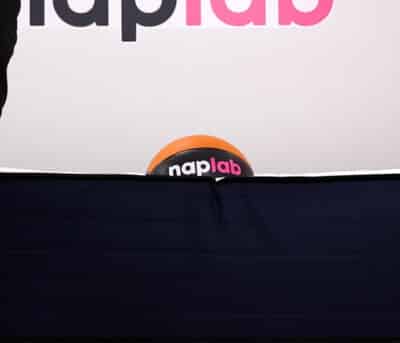
The NapQueen Victoria has a high level of bounce. During our tests, we measured a total bounce height of 10.99″. This is 2.28″ more bounce than the average of 8.71″, based on all of our tests to date.
Max. Depth
6.49″
Max. Rebound
4.50″
Total Bounce
10.99″
The higher bounce on this mattress can be attributed to two major design choices. First, we have a very thin 2.0” foam comfort layer. Thicker foam layers can have a suppressive effect on bounce, but when there is simply less foam, we see higher levels of bounce delivered.
And second, we have a tall 10.0” coil unit. The combination of a springy, resilient, bouncy coil unit and a thin 2.0” foam comfort layer sets the stage for higher bounce levels.
Max. Sinkage Depth
Max. Bounce Height
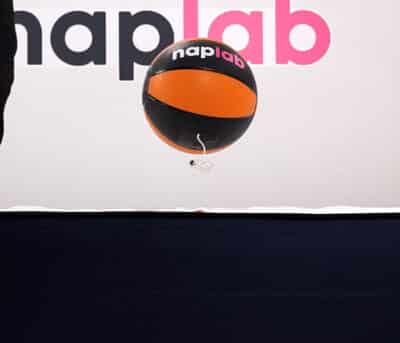
The level of bounce is also documented in the video below.
The increase in bounce improves the ease of movement and sex performance on this mattress. However, the higher bounce is also the reason that motion transfer was far from great. As such, there are pros and cons to consider.
Edge Support Test
The NapQueen Victoria has excellent sitting edge support and good lying edge support.
Max. Sinkage
3.50″
Lying Support
Good
Reinforced Edge
Yes
In our sitting edge support test, we measured a sitting sinkage compression of 3.50″. This is 0.39″ less sitting sinkage than the average of 3.89″, based on all of our tests to date.
The level of edge support while seated is documented in the images below.
Sitting, 140 lbs.

Sitting, 200 lbs.

While lying directly on the edge of the mattress, I felt that the support was good in all sleeping positions.
Despite the low price, the NapQueen Victoria is equipped with reinforced coils along the perimeter of the mattress. These reinforced coils seem to be having a strong, positive impact on the edge support for both sitting and lying.
The level of edge support while lying is documented in the images below.
Lying on Edge, 140 lbs.
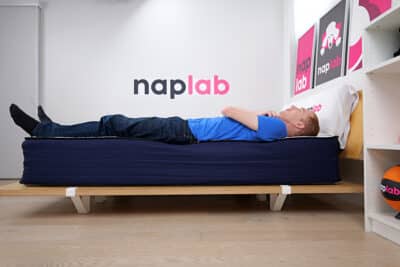
Lying on Edge, 200 lbs.
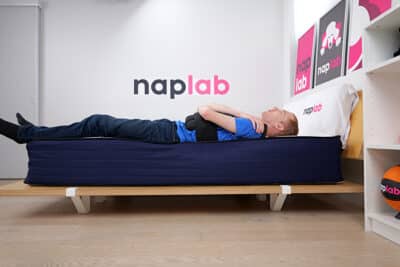
In addition, while it’s not beneficial for comfort or pressure relief, the limited 2.0” comfort layer is also contributing to the better-than-average edge support. While the edge support is far from perfect, it’s more than good enough, especially when considering the price point.
Sex Test
The NapQueen Victoria has excellent sex performance. First up, let’s talk about what the Victoria does best. Noise is minimal, and both edge support and bounce earned excellent scores.
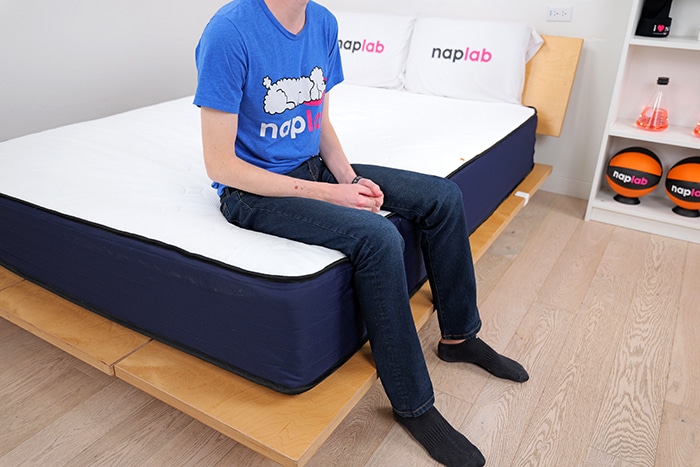
Sitting edge sinkage measured in at 3.50”. This is better than average and the more robust edge extends the sexable surface area of the mattress. In addition, bounce is also measured at a higher than average level with 10.99”.
| Sex Factor | Factor Weight | Score | Rating |
|---|---|---|---|
| Bounce | 65% | 9.4 | Very High |
| Edge Support | 20% | 9.4 | Excellent |
| Noise | 5% | 10 | Minimal |
| Pressure Relief | 5% | 6.0 | Mediocre |
| Cooling | 5% | 5.0 | Poor |
The extra bounce makes sex easier, less tiring, and more enjoyable. When it comes to sex, more bounce is almost always better than less. All that said, it’s not all smooth sailing.
The Victoria mattress has mediocre pressure relief and poor cooling performance. These negative factors make the overall comfort experience on the mattress far from ideal. Even so, the mattress performs considerably better than average where it counts with edge support and bounce.
Despite the weak performance from cooling and pressure relief, the NapQueen still earned an excellent sex score.
Pressure Relief Test
The NapQueen Victoria has a mediocre level of pressure relief. During our tests, I felt notable pressure points on my body.
Comfort Layer
2.00″
Support Layer
10.00″
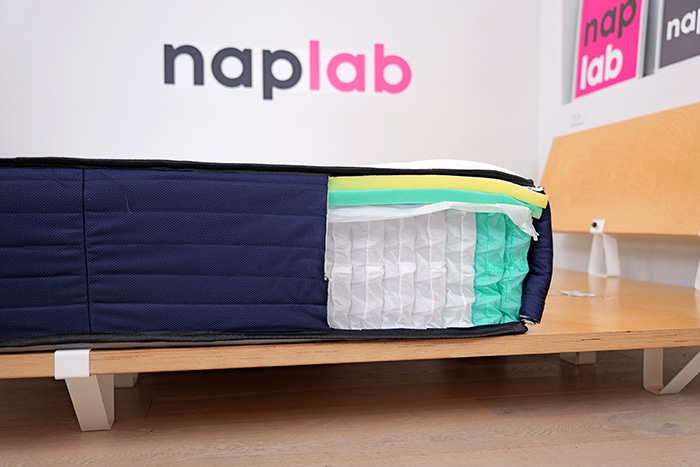
The mattress is equipped with 2.0″ of comfort material, which is 2.32″ less comfort material than the average comfort layer thickness of 4.32″, based on all of our tests to date. Beyond simply having an insufficient level of comfort material, the material quality leaves much to be desired.
In all mattress tests, we make it a point to cut open the mattress and examine the materials. In my view, the material quality is fine, and yet also far from good. Even so, it’s basically what I expect at this price point.
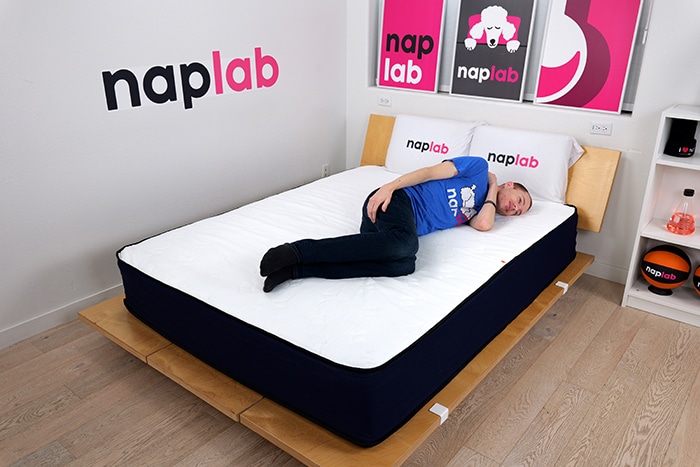
The combination of a significantly thinner than average comfort layer and limited foam quality both contribute to the mediocre pressure relief. Lastly, let’s talk about the foam types. According to the NapQueen product page, this mattress uses memory foam. However, based on our testing and my assessment, it feels more like a typical poly foam.
The foam layers don’t create a significant body hug, create more of a floating feel, and are highly responsive. This isn’t good or bad, but if you’re expecting a memory foam mattress, I think you are going to be disappointed by the feel.
Pressure Map – Side Sleepers

| Pressure Relief (PSI) | Average | Maximum |
|---|---|---|
| Side Sleepers | 0.11 | 0.39 |
Pressure Map – Back Sleepers

| Pressure Relief (PSI) | Average | Maximum |
|---|---|---|
| Back Sleepers | 0.06 | 0.56 |
Pressure Map – Stomach Sleepers

| Pressure Relief (PSI) | Average | Maximum |
|---|---|---|
| Stomach Sleepers | 0.07 | 0.41 |
When I consider our objective pressure mapping tests, material thickness, material quality, and my subjective experience on the mattress, I’m confident most sleepers will find the pressure relief to be mediocre.
Off-Gassing Test
The NapQueen Victoria had a strong smell upon the initial unboxing. The mattress smelled for 14 days. This is 6.7 days longer than the average smell duration of 7.3 days.
Initial Smell Strength
Strong
Off-Gassing Period
14 days
Company
NapQueen mattresses come with a 100-night trial period and a 10-year warranty. Shipping and returns are both free.
| Company Factor | Factor Weight | Score | Data |
|---|---|---|---|
| Returns | 40% | 10 | $0 |
| Trial Period | 30% | 8.0 | 100 nights |
| Warranty | 20% | 8.0 | 10 years |
| Shipping | 10% | 10 | $0 |
| Country of Origin | 0% | USA |
Comparing 110+ brands tested to date, the average trial period is 182 nights, 82 nights more than NapQueen offers.
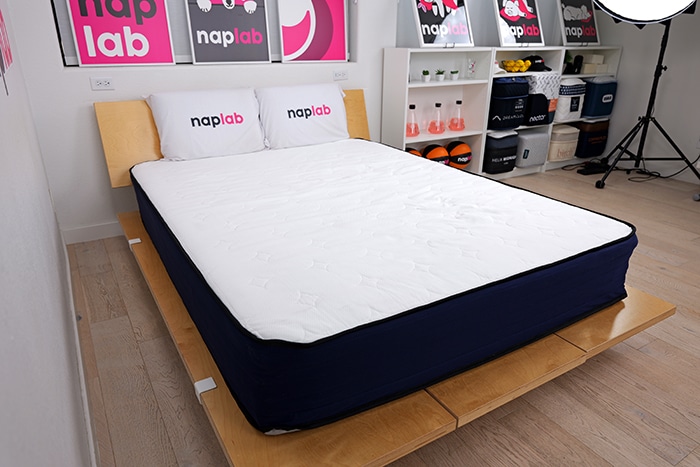
Additionally, the average warranty is 13 years, which is 3 years more than NapQueen. This average warranty excludes the 41% of mattresses that offer lifetime warranties, so all things considered, a 10-year warranty is fine, but nothing amazing.
How firm is NapQueen Victoria?
The Napqueen Victoria is available in multiple height options, including 8”, 10”, and 12”. Our tests were on the 12” version.
Regardless of your height choice, the Napqueen Victoria has a medium-firm feel, which is a rating of 6 out of 10, where 10 is the most firm.

Support & Sleeping Positions
Support on the NapQueen Victoria is mediocre. During our tests, I felt that support was notably lacking in all sleeping positions. The mattress is equipped with a 10.0″ support layer. This is 2.08″ thicker than the average support layer thickness of 7.92″, based on all of our tests to date.
| Support Factor | Data |
|---|---|
| Comfort Layer | 2.00″ |
| Support Layer | 10.00″ |
| Firmness | Medium-Firm |
| Body Contour | Slight |
| Zoned Support | No |
| Reinforced Edge | Yes |
On paper, the material specs look fine. However, the coil unit and the comfort foams leave much to be desired. In a word, these materials feel “cheap,” and while lying on the mattress, I simply do not feel well supported.
The foams failed to create sufficient pressure relief and the coils failed to fully support the body. It’s unclear exactly how much is the fault of the coils and how much is the fault of the foams, but what is clear is that the total support experience struggles greatly.
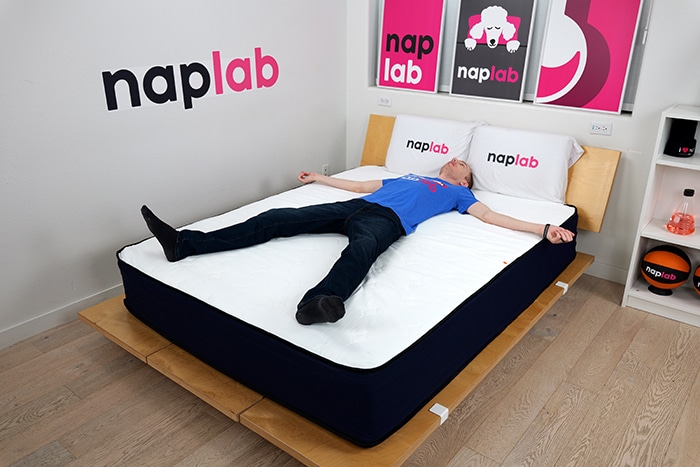
Check out the table below to see the sleeper weights and sleeping positions that would be best suited for this mattress.
| Sleeper Weight | Stomach Sleeper | Side Sleeper | Back Sleeper |
|---|---|---|---|
| Under 150 lbs. | Maybe | Maybe | Maybe |
| 150-250 lbs. | Maybe | Maybe | Maybe |
| 250-300 lbs. | Maybe | Maybe | Maybe |
I found it difficult to lie on the mattress in any position for an extended period of time. In each test, my body quickly experienced pressure points and a general lack of comfort, resulting in a disappointing level of support.
Perhaps this mediocre level of support could be forgiven given the super cheap price point. Even so, while the price is low, the cost to your body through the mediocre support and mediocre pressure relief is high. As such, I have a hard time recommending this mattress to anyone.
Based on all of my tests to date, an analysis of the materials, and my subjective experiences, I’m confident that most sleepers will find support on the NapQueen Victoria is mediocre.
Design
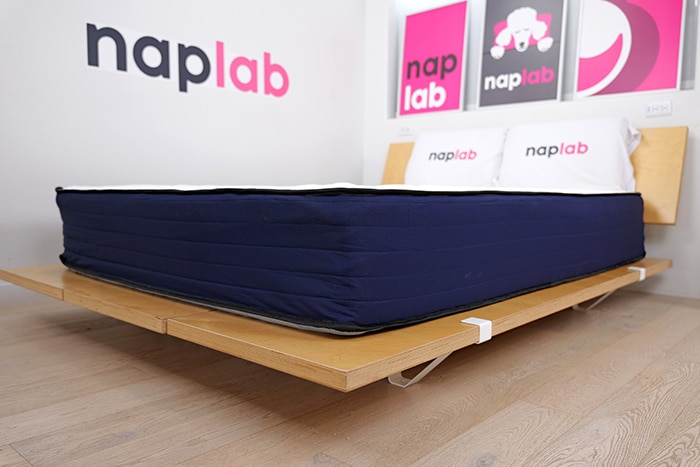
The NapQueen Victoria is a 12.00″ hybrid mattress that comes in a single firmness option—Medium-Firm. It’s a budget-friendly hybrid and is easy to order via Amazon.
| Design Factor | Data |
|---|---|
| Type | Hybrid |
| Thickness | 12.00″ |
| Cover Type | Thin |
| Weight | 76 lbs. |
| Has Handles | No |
| Fiberglass-Free | Yes |
| Ships in a Box | Yes |
This mattress has a thin cover and a simple design. It skips fancy “bells and whistles” like cooling covers or handles on the side. It ships from Amazon, compressed in a box, straight to your door.
Materials
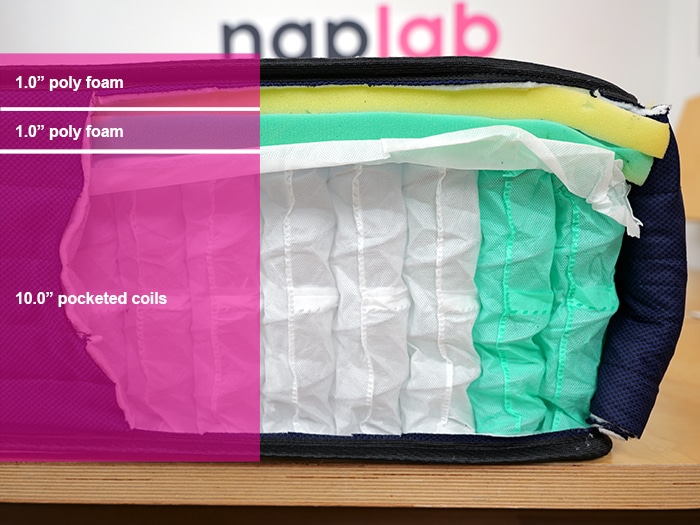
The NapQueen Victoria is 12.00″ thick and contains a combination of poly foam and coil supports. From top to bottom, here is a full list of the materials used in this mattress:
| Layer Type | Thickness | Layer Specs |
|---|---|---|
| Poly Foam | 1.00″ | Not Available |
| Poly Foam | 1.00″ | Not Available |
| Pocketed Coils | 10.00″ | Not Available |
The Law Tag outlines the full breakdown of materials included in this mattress.
- Materials
- 56% polyurethane foam
- 23% polyester fiber
- 13% rayon fiber
- 8% viscoelastic polyurethane foam
- Coil spring unit
- Top Cover
- 100% polyester
- Bottom Cover
- 55% rayon
- 40% polyester
- 5% aramid
- Made by: Adven Group LLC. 611 S. Cravens Rd. Suite 300, Missouri City, TX 77489
- Date of Delivery:
- Finished Size: 80 in. x 60 in.
- Net Weight of Filling Mat: 25lbs.
- Made in USA
- Manufactured by: Adven Group LLC. 611 S. Cravens Rd. Suite 300, Missouri City, TX 77489
- Date of Manufacture:
- Model: NQV21231
The Cover
The NapQueen Victoria has a thin cover with class diamond-stitching that holds the materials together. It is soft to the touch and has a bit of stretch to it.
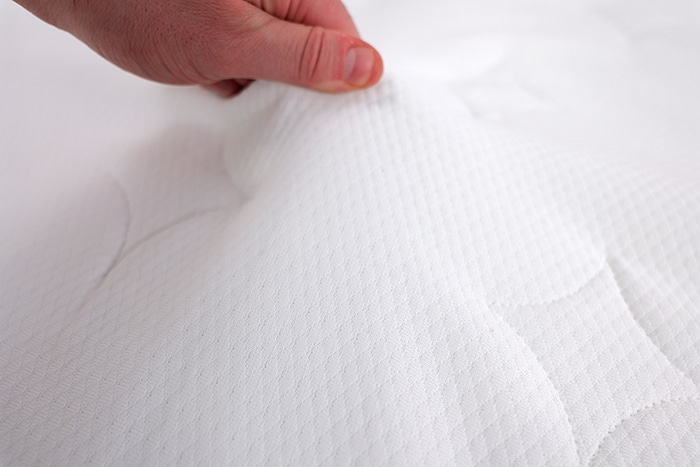
The sides of the mattress use a thicker dark blue fabric. This is good for durability and also helps the mattress look cleaner as well.
The Comfort Layer
The comfort layer is 2.00″ thick and made of two 1.0″ layers of poly foam. These two layers are directly below the cover.
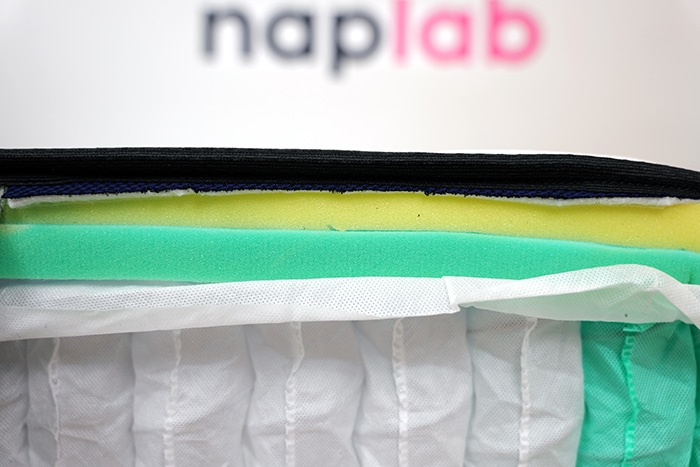
They are identical in thickness, but not in color. That said, the exact differences between these two layers is not disclosed by the company in the provided specifications.
The Support Layer
The support layer is 10.00″ thick and made of a 10.0″ pocketed coil support base. This is a bit thicker than the standard hybrid.
Typically, we see 8.0″ coils, and if the support layer is thicker, it would come from a support foam base at the bottom of the mattress (1-2″ thick).
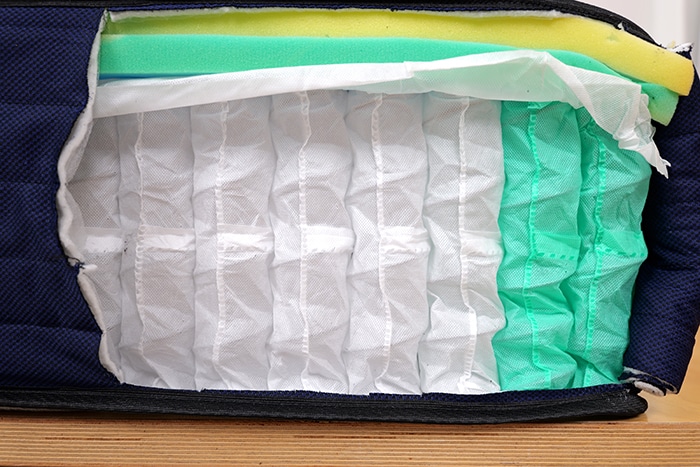
While a thicker support layer can be good for support, it’s not ideal for pressure relief, since in this case, it comes at the expense of a thicker comfort layer.
Product Evolution
NapQueen has been around since 2017, getting their start based out of Texas. The company started selling mattresses online around 2020. It does not appear there have been any notable product changes since the mattress launched in 2020.
Other Mattresses to Consider
Not sure if the NapQueen Victoria is the right pick for you? Check out these three other top-rated hybrid mattresses for alternatives under $700 you may want to consider.
For Performance
Dreamcloud Hybrid
12.5″ Hybrid Under $700
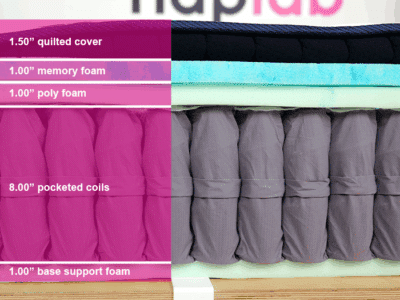
The Dreamcloud Hybrid is a 12.5″ hybrid mattress available in 1 firmness level—medium-firm. This mattress has significantly better overall performance. For a hybrid on a budget, the DreamCloud is the better value and also offer better performance.
For Slightly Firmer Feel
Origin Adapt Hybrid
Less Sinkage + Bounce
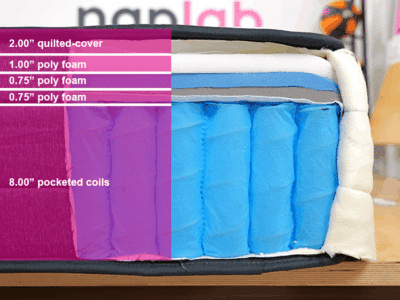
The Origin Adapt Hybrid is a 12.5″ hybrid mattress available in 1 firmness level—slightly firm. This mattress has only moderate sinkage or bounce, offering less engagement compared to the Victoria. For back or stomach sleepers, the Origin Adapt would be a better option.
For Under $500
SweetNight Twilight
Better Cooling + Pressure Relief
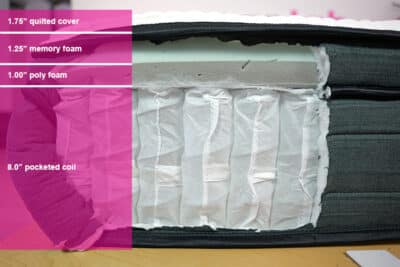
The SweetNight Twilight is a 12″ hybrid mattress available in 1 firmness level—medium-firm. This mattress has the lowest price among all 3 alternative picks, while still having better cooling and pressure relief than the NapQueen Victoria.
Frequently Asked Questions
Still have questions? Check out some of the top FAQs on the NapQueen Victoria mattress below and get the answers you’re looking for.
How much does a NapQueen Victoria mattress cost?
Here are the current prices of the 12″ Firm version, with any sales or promotions reflected below:
Twin: $152
Twin XL: $160
Full: $195
Queen: $228
King: $248
Cal. King: N/A
*Note: Sales prices are subject to change without notice or warning.